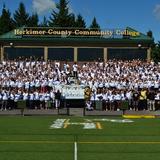
Mohawk Valley Community College

1101 Sherman Dr
Utica, NY 13501
Top-Ranked (2026-27): View Rankings
  • MVCC offers choice, opportunity, and hope by providing accessible and affordable higher education, training, and services that emphasize academic excellence, diversity and a global view. The College is committed to excellence in career and transfer preparation, business, economic and community development, and personal and cultural enrichment.

School Highlights

Mohawk Valley Community College serves 5,940 students (41% of students are full-time).
The college's student-teacher ratio of 37:1 is higher than the state community college average of 24:1.
Minority enrollment is 43% of the student body (majority Black and Hispanic), which is less than the state average of 63%.

Quick Facts (26-27)

  • Enrollment: 5,940 students
  • In-state tuition: $4,415
  • Out-state tuition: $8,225
  • Student-teacher ratio: 37:1
  • Minority enrollment: 43%
  • Source: Integrated Postsecondary Education Data System (IPEDS)

Top Rankings

Mohawk Valley Community College ranks among the top 20% of public schools in New York for:

Category
Attribute
Affordability
Community Size

School Overview

The teacher population of 162 teachers has declined by 68% over five years.
Mohawk Valley Community College
(NY) Community College Avg.
Carnegie Classification
Associate's Colleges
Institution Level
At least 2 but less than 4 years
Institution Control
Public
Private not-for-profit
Total Faculty
162 staff
43 staff
School Calendar

Student Body

The student population of Mohawk Valley Community College has stayed relatively flat over five years.
The student-teacher ratio of 37:1 has increased from 12:1 over five years.
The Mohawk Valley Community College diversity score of 0.63 is less than the state average of 0.76. The school's diversity has grown by 48% over five years.
Total Enrollment
5,940 students
953 students

Showing 2012–2025. Full 19-year historical data available below ↓

Student-Teacher Ratio
37:1
24:1
# Full-Time Students
2,434 students
528 students

Showing 2012–2025. Full 19-year historical data available below ↓

# Part-Time Students
3,506 students
425 students

Showing 2013–2025. Full 19-year historical data available below ↓

# Enrollment Undergraduate
5,940 students
717 students
# Full-Time Undergraduate Students
2,434 students
511 students

Showing 2013–2025. Full 19-year historical data available below ↓

# Part-Time Undergraduate Students
3,506 students
495 students
Total Dormitory Capacity
459 students
382 students

Showing 2010–2023. Full 17-year historical data available below ↓

% Asian
6%
8%

Showing 2008–2025. Full 19-year historical data available below ↓

% Hispanic
7%
23%

Showing 2008–2025. Full 19-year historical data available below ↓

% Black
7%
19%

Showing 2008–2025. Full 19-year historical data available below ↓

% White
57%
37%

Showing 2010–2025. Full 19-year historical data available below ↓

% Two or more races
3%
3%
% Non Resident races
1%
3%
% Unknown races
18%
7%
Diversity Score
0.63
0.76

Showing 2011–2025. Full 19-year historical data available below ↓

College Completion Rate (Students who graduate in less than 4 years)
33%
35%

Showing 2015–2025. Full 19-year historical data available below ↓

Average Graduate Earnings (10 Years)
$33,700
$35,300

Tuition & Financial Aid

The public in-state tuition of $4,415 is less than the state average of $5,849. The in-state tuition has declined by 19% over four years.
The public out-state tuition of $8,225 is less than the state average of $10,299. The out-state tuition has grown by 5% over four years.
In-State Tuition Fees
$4,415
$5,849
Out-State Tuition Fees
$8,225
$10,299
Tuition Notes
$5,266 yearly tuition
% Students Receiving Some Financial Aid
83%
89%

Showing 2012–2025. Full 19-year historical data available below ↓

Median Debt for Graduates
$10,500
$13,500

Showing 2008–2020. Full 14-year historical data available below ↓

Median Debt for Dropouts
$5,500
$5,500

Showing 2008–2020. Full 14-year historical data available below ↓

Source: 2025 (or latest year available) Integrated Postsecondary Education Data System (IPEDS) , School Administrators

School Notes

  • The college offers Degrees and Certificate in Art, Business and Information Technology, Engineering, Computer, and Physical Sciences, Engineering Technologies and the Trades, Health Services, Hospitality Programs, Humanities, Life Science, Mathematics, Physical Education, Psychology, Human Services and Education and Social Sciences. The Center for Community and Economic Development at Mohawk Valley Community College is the primary educational resource and training provider for individuals, businesses, and other agencies in the college service area. We are responsive to the educational and training needs of this community through a comprehensive offering of flexible and innovative training programs and services. Mohawk Valley Community College is accredited by the Middle States Commission on Higher Education. Our Civil, Mechanical, and Electrical Engineering Technology curricula, and the Surveying Technology curriculum are accredited by the Technology Accreditation Commission of the Accreditation Board for Engineering and Technology (TAC-ABET). The Nursing curriculum is accredited by the National League Accrediting Commission.

Frequently Asked Questions

How much does Mohawk Valley Community College cost?
Mohawk Valley Community College's tuition is approximately $4,415 for In-State students and $8,225 for Out-State students.
What is Mohawk Valley Community College's ranking?
Mohawk Valley Community College ranks among the top 20% of community college in New York for: Least expensive tuition and Largest student body.

Recent Articles

Licensure Pass Rates: What Students Should Check
Learn how to evaluate licensure pass rates before enrolling in community college career programs, compare exam results, identify warning signs, and choose training that supports professional licensing and employment goals.
Do Your Transfer Credits Count Toward Your Major?
A college course may transfer without counting toward your major. Learn how to check degree requirements, identify elective credits, avoid graduation delays, and protect your community college transfer plan.
Transfer With 45 Credits, 60 Credits, or a Degree?
Should you transfer with 45 credits, 60 credits, or an associate degree? Compare university requirements, tuition savings, graduation timelines, and transfer benefits to choose the best path for your goals.

Quick Facts (26-27)

  • Enrollment: 5,940 students
  • In-state tuition: $4,415
  • Out-state tuition: $8,225
  • Student-teacher ratio: 37:1
  • Minority enrollment: 43%
  • Source: Integrated Postsecondary Education Data System (IPEDS)

Related School Videos

Quick Links