
Updated
|
Why the Male Population is Spiking at Community Colleges
Learn about the changing tide in male enrollment at community colleges, as well as the catalysts behind the increase in men on campus.

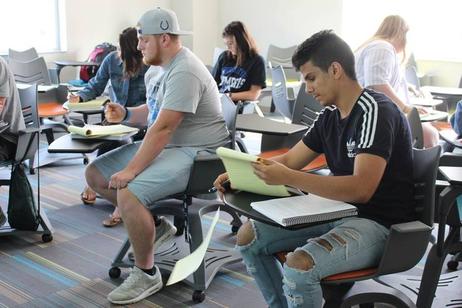
Although women were at one time excluded from many institutions of secondary education, in recent years, they have established themselves as a majority presence on two-year and four-year college campuses. According to a December 2009 Washington Post report, women make up 60% of higher education students nationwide, primarily because men are more likely to drop out of school, join the military, or go to prison.

However, the tide may be beginning to shift at community colleges, where male enrollment has been on the increase. Inside Higher Ed reports that for the first time in years, community colleges have experienced enrollment of male students either equal to or above their enrollment of female students.

A Spike in Male Students

Randolph Community College, in North Carolina, experienced an increase of 68% in first-time full-time male enrollment from Fall 2008 to Fall 2009, bringing the current male population at the community college up to 37%. Meanwhile, in Washington State, Lower Columbia College noted that full-time male student enrollment was 36% higher in Fall 2009 than it had been in Fall 2008.

This video offers ten tips on how to succeed in college.

Inside Higher Ed reports that Kent Phillipe, the director of research at the American Association of Community College, notes that the group’s recent studies show that the number of male students at community colleges has grown

. . .read more

How CalPASS Has Improved the Success of California's Community College Students

Updated
|
How CalPASS Has Improved the Success of California's Community College Students
Learn about California's CalPASS program and how it has benefited community college students and their transition to four-year universities.

A majority of California’s school districts, community colleges, and four-year universities are participating in CalPASS, a groundbreaking program that is improving their students’ academic success.

The CalPASS program makes student achievement data from kindergarten through college available to teachers of all levels. The San Diego Union-Tribune reports that CalPASS “has collected 346 million student records on 25 million students, including information on demographics, student performance and test scores.” However, students’ test scores are not connected to any personal or identifying information. Instead, teachers, professors, and administrators at all levels of California’s public education system can view the data trends, using the information to determine their instructional decisions.

CalPASS, which stands for California Partnership for Achieving Student Success, is based in Grossmont Community College in San Diego. It was started in 1998, when Brad Phillips, then the director of research, planning, and academic services at Grossmont, realized that there was no existing channel through which he could ascertain how students from his two-year college were performing academically after they transferred to four-year colleges. Phillips decided that he needed to create such a system so that teachers and administrators could use the information to improve how students are taught.

From the CalPASS website: "Cal-PASS Plus, created through leadership and funding by California Community College Chancellor’s Office, is an accessible, actionable and collaborative pre-K through 16 system of student data.

Cal-PASS Plus’ mission is to provide actionable data to help improve student success along

. . .read more

Careers: Sustainable Energy Technician

Updated
|
Careers: Sustainable Energy Technician
With the change in energy production trends, sustainable energy technology careers are in high demand, and you can start your training for a highly-demanded career right at your local community college.

In today’s difficult job market, community college students looking to position themselves for career security and success have an exciting new set of options to consider: programs leading to associate’s degrees or certificates in sustainable energy technologies.

A Growing Industry

Just a few years ago, sustainable energy was more of a dream than a reality. Today, sustainable energy is emerging as an industry in its own right – one that demands trained, competent workers. The American Recovery and Reinvestment Act of 2009 (President Obama’s economic stimulus package) provides money for “solar farms, wind turbines, electrical grid updates, mass transit, and the weatherizing and retrofitting of buildings,” according to Business Week. By the estimates of some environmental groups, this spending is expected to produce 1 million to 1.5 million new jobs.

Reporting on the then-emerging trend in 2008, the New York Times articulated that national starting salaries for sustainable energy workers range from $35,000 to $45,000 for graduates of two-year degree programs.

Fortunately for college students who are attracted to the growth potential and solid starting salaries in this industry, community colleges are beginning to offer more programs in two-year degrees or certificates for prospective sustainable energy industry workers.

This video reports on Renewable Energy Program at Hutchison Community College.

Sustainable Energy Degree and Certificate Programs

Across the country, community colleges are offering niche programs that can jumpstart your career in

. . .read more

Alternative Automobiles: New Training Programs at Community College

Updated
|
Alternative Automobiles: New Training Programs at Community College
Learn about the demand for technicians of alternative fuel automobiles and its future career potential. Start your career as an alternative fuel vehicle technician at your local community college.

The past decade has seen an explosion of hybrid cars powered by alternative fuels, rather than traditional gasoline. What once seemed a science fiction dream – powering cars with energy other than petroleum – is quickly becoming a reality. However, alternative fuels don’t stop with hybrid engines; experts are working on creating vehicles that can be powered by compressed natural gas, biodiesel, ethanol, and propane.

As the landscape of the American auto industry shifts to include more alternative fuel vehicles, there is an emerging market for auto technicians who are trained to service and repair these next-generation cars. For those looking for a career in the auto industry with definite growth potential, a new training program for alternative fuel technicians available at community colleges could be an excellent investment.

This video offers a brief overview of the alternative fuels training at the Santa Fe Community Colleges.

Alternative Fuels Training Centers

West Virginia University started the National Alternative Fuels Training Consortium (NAFTC) in 1992 to address the lack of technicians who were trained to work with the then-new Alternative Fuel Vehicles. In 1995, the NAFTC added six technical training centers to the existing West Virginia University center. Since then, the program has grown to include 42 members: 41 national training centers and 1 associate training center.

The training centers are located in community colleges and other institutes of higher education from California to Maine.

. . .read more

How to Guarantee Your Admission to a State University after Community College

Updated
|
How to Guarantee Your Admission to a State University after Community College
Discover how guaranteed admission and transfer agreements help community college students save money, transfer credits, and gain access to four-year universities through streamlined pathways to bachelor's degrees in 2026.

In these times of tighter family budgets and increased competition for admission to four-year universities, community college students may worry about their prospects for transferring to a university after earning an associate’s degree.

However, many students can put their minds at ease, especially if they live in an area where local community colleges have entered into guaranteed admission agreements with four-year state universities. Students planning this route may also benefit from Community College Review’s guide to transferring from community college to a university in 2026.

What follows is an overview of some states that are leading the way in guaranteed admission and articulation agreements:

Abigal Endsley writes on Pearson.com, one of the leading providers of educational materials:

“So before contacting your local community college, first decide what degree you want and where you want to graduate from. This, admittedly, is a monster of a task in and of itself.

Then you’ll need to know what’s required to earn that specific degree from that specific school. What kinds of courses do you need? What subject? What specificity? What level? Check the college’s website for this information.

Once you understand what degree you want, where you want to earn it from, and your degree’s specific college credit requirements, only then can you begin researching which of those credits you can transfer from a community college.”

Hawaii

Students who earn an associate’s degree from one of the seven community colleges in the University of Hawaiʻi System

. . .read more

Recent Articles

Healthcare Workforce Programs: Fast Track or Overcrowded Path?
Explore whether community college healthcare programs still offer a fast track to rewarding careers or if growing enrollment and competition are changing the landscape.
How to Judge Job Placement Claims Before Enrolling
Learn how to evaluate community college job placement claims, understand employment statistics, and identify programs with proven career outcomes before you enroll.
Employer Partnerships: Real Hiring Pipeline or Marketing Claim?
Explore how community college employer partnerships work, learn how to identify genuine hiring pipelines, and discover the questions every prospective student should ask before enrolling in a career-focused program.