Community College vs. Bootcamps: Which Is Better for Tech Careers in 2026?
The debate over community college vs. bootcamps has intensified as the technology job market evolves in 2026. Parents, students, and educators are asking whether a traditional academic pathway or an accelerated training model better prepares learners for tech careers. With rising tuition concerns, shifting employer expectations, and rapid changes in artificial intelligence, cybersecurity, and software development, the community college vs. bootcamps question has real financial and career implications.
This article examines community college vs. bootcamps through the lens of cost, curriculum, credentials, employer perceptions, and long-term outcomes. By the end, readers should have a clearer understanding of which option fits different types of learners and career goals in 2026.
Understanding the Two Pathways
What Community Colleges Offer in 2026
In the community college vs. bootcamps discussion, community colleges represent the more traditional route. Community colleges offer associate degrees, certificates, and transfer pathways aligned with regional workforce needs. In 2026, many community colleges have modernized their technology programs, adding applied AI, cloud computing, data analytics, and cybersecurity tracks.
Key features include:
- Accredited associate degrees in computer science, information technology, and software development
- General education courses that build communication, math, and critical thinking skills
- Partnerships with local employers and four-year institutions
- Eligibility for federal financial aid and workforce grants
Community colleges often appeal to students seeking a well-rounded education and flexibility. For many families weighing community college vs. bootcamps, the affordability and academic credibility of community colleges remain major advantages.
What Tech Bootcamps Offer in 2026
Bootcamps represent the fast-track option in the community college vs. bootcamps comparison. These programs focus on job-ready skills in areas such as web development, UX design, data science, and cybersecurity. In 2026, bootcamps increasingly emphasize AI-assisted coding tools, project-based learning, and employer-aligned curricula.
Typical bootcamp characteristics include:
- Short-term programs, often 12 to 24 weeks
- Intensive, skills-focused instruction
- Limited or no general education coursework
- Career services such as interview prep and portfolio reviews
For learners eager to enter the workforce quickly, bootcamps remain an attractive side of the community college vs. bootcamps debate.
Cost and Financial Considerations
Cost is often central to the community college vs. bootcamps decision. Community colleges typically charge significantly less per credit hour than four-year institutions. According to the U.S. Department of Education, average annual tuition at community colleges remains under $4,000, and many students qualify for grants that reduce out-of-pocket costs.
Bootcamps, by contrast, often cost between $10,000 and $20,000 for a few months of training. Some bootcamps offer income-share agreements, but these arrangements can result in higher long-term costs.
In the community college vs. bootcamps cost comparison:
- Community colleges offer predictable tuition and financial aid access
- Bootcamps provide speed but often at a higher upfront price
- Community colleges allow students to work part-time while studying
For cost-conscious families, community college vs. bootcamps often tilts toward community colleges.
Curriculum Depth and Breadth
Curriculum is another critical factor in the community college vs. bootcamps analysis. Community colleges emphasize foundational knowledge alongside technical skills. Students learn programming, databases, and systems, but also statistics, writing, and teamwork.
Bootcamps focus narrowly on current tools and languages. This approach can be effective for immediate job placement, but critics argue it may limit adaptability as technologies change.
In 2026, employers increasingly value problem-solving and learning agility. The community college vs. bootcamps curriculum comparison often shows:
- Community colleges build long-term technical literacy
- Bootcamps emphasize rapid skill acquisition
- Community colleges support continued education and advancement
Credentials and Employer Perceptions
Credentials matter in the community college vs. bootcamps debate. An associate degree from an accredited institution carries broad recognition. Many employers use degrees as screening tools, particularly for government, healthcare, and enterprise IT roles.
Bootcamp certificates vary widely in reputation. Some employers value specific bootcamps with strong placement records, while others remain skeptical.
According to hiring trends highlighted by the U.S. Bureau of Labor Statistics, most tech occupations still list postsecondary education as a preferred qualification, reinforcing the credential advantage in the community college vs. bootcamps discussion.
Job Placement and Career Outcomes
Job outcomes are central to evaluating community college vs. bootcamps. Bootcamps often advertise high placement rates, but methodologies vary. Community colleges track outcomes over longer periods, including promotions and degree transfers.
In 2026, many community colleges integrate paid internships and apprenticeships into tech programs, narrowing the experiential gap often cited in community college vs. bootcamps comparisons.
Career outcome trends include:
- Bootcamp graduates entering junior developer or support roles
- Community college graduates accessing broader IT and analyst positions
- Stronger long-term mobility for degree holders
Flexibility and Student Experience
Flexibility plays a major role in community college vs. bootcamps decisions. Community colleges offer evening, online, and hybrid classes that accommodate working adults and parents. Bootcamps often require full-time commitment during short periods.
For students balancing family or employment, community college vs. bootcamps often favors community colleges due to scheduling options and support services.
Equity, Access, and Support Services
Community colleges are deeply rooted in local communities. They provide tutoring, advising, disability services, and career counseling. These supports are particularly important for first-generation college students.
Bootcamps vary in support offerings. Some provide strong mentorship, while others focus narrowly on instruction.
From an equity perspective, community college vs. bootcamps often highlights the inclusive mission of community colleges.
Technology Trends Shaping the Decision in 2026
Several trends are reshaping the community college vs. bootcamps landscape:
- AI tools reducing entry-level coding barriers
- Increased employer demand for cybersecurity and cloud skills
- Growth of stackable credentials and micro-certificates
Community colleges now offer industry-aligned certificates endorsed by organizations such as CompTIA, which adds credibility to the community college vs. bootcamps comparison.
Side-by-Side Comparison
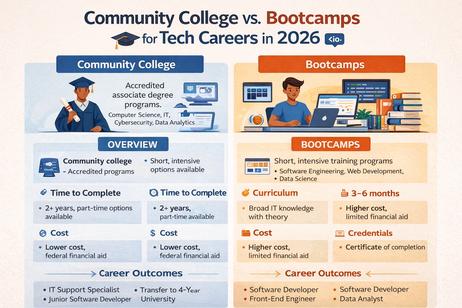
| Factor | Community College | Bootcamps |
|---|---|---|
| Time to completion | 1 to 2 years | 3 to 6 months |
| Cost | Lower, aid available | Higher, limited aid |
| Credential | Accredited degree or certificate | Non-accredited certificate |
| Curriculum | Broad and foundational | Narrow and skills-focused |
| Flexibility | High | Moderate to low |
This table summarizes key community college vs. bootcamps differences for 2026.
Which Path Is Better for Tech Careers in 2026?
The answer to community college vs. bootcamps depends on the learner. Bootcamps may suit career changers with prior degrees who need rapid upskilling. Community colleges are often better for students seeking affordability, recognized credentials, and long-term career growth.
Educators and counselors increasingly recommend community colleges as a starting point, with bootcamps serving as supplements rather than substitutes.
Final Takeaway
In 2026, the community college vs. bootcamps decision is not about choosing a winner but about matching goals to pathways. Community colleges offer depth, affordability, and resilience in a changing tech economy. Bootcamps offer speed and focus for specific roles.
For most students planning sustainable tech careers, community college vs. bootcamps often resolves in favor of community colleges, particularly when paired with internships and industry certifications. Families and learners should assess readiness, resources, and long-term objectives before deciding which side of the community college vs. bootcamps debate best fits their future.