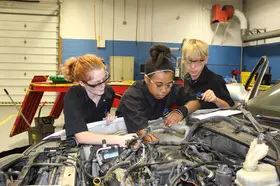
- Danville Area Community College is committed to being a recognized leader in providing quality, innovative and adaptive programs and services which meet the life-long academic, cultural and work force needs of our diverse community.
School Highlights
Quick Facts (26-27)
- Enrollment: 2,297 students
- In-state tuition: $6,375
- Out-state tuition: $6,375
- Student-teacher ratio: 31:1
- Minority enrollment: 40%
- Source: Integrated Postsecondary Education Data System (IPEDS)
Top Rankings
Danville Area Community College ranks among the top 20% of public schools in Illinois for:
School Overview
Student Body
Showing 2012–2025. Full 19-year historical data available below ↓
Showing 2012–2025. Full 19-year historical data available below ↓
Showing 2012–2025. Full 19-year historical data available below ↓
Showing 2012–2025. Full 19-year historical data available below ↓
Showing 2008–2025. Full 19-year historical data available below ↓
Showing 2008–2025. Full 19-year historical data available below ↓
Showing 2010–2025. Full 19-year historical data available below ↓
Showing 2011–2025. Full 19-year historical data available below ↓
Showing 2015–2025. Full 19-year historical data available below ↓
Tuition & Financial Aid
Showing 2008–2024. Full 18-year historical data available below ↓
Showing 2012–2025. Full 19-year historical data available below ↓
Showing 2008–2020. Full 14-year historical data available below ↓
Showing 2008–2020. Full 14-year historical data available below ↓
Sports
School Notes
- Danville Area Community College is a public two-year college located in Danville, Illinois. DACC was founded in 1946 and has grown into an independent college serving about 5,000 students per year in over 1,500 unique courses. Students at DACC are enrolled in programs and courses including: college transfer, occupational degrees and certificates, re-training, skill development, customized training or areas of special interest. Danville Area Community College is an accredited public two-year community college providing higher education opportunities for youth and adults in East Central Illinois. Established initially as an extension center of the University of Illinois in 1946, DACC became a public junior college named Danville Community College under Danville Public Schools in 1949. In 1951, the name was changed to Danville Junior College. In June of 1966, the College separated from Danville School District No. 118 under provisions of the Public Junior College Act and became an independent two-year area college under the control of the Board of Trustees of Junior College District No. 507. The name Danville Junior College was changed to Danville Area Community College on July 1, 1979, to be more reflective of the services rendered. The College district encompasses high school districts in Vermilion, Edgar, Iroquois, Ford, and Champaign counties with an estimated population 112,000. Originally housed at Danville High School, the college was moved to its current location in 1965. DACC is located on an attractive 75-acre campus on the south-east side of Danville, acquired from the Veterans Administration in 1965. Several of the existing buildings, constructed around the turn of the century, were renovated; partial funding for this renovation was provided by generous public support of the Danville Junior College Foundation Drive in 1965. DACC offers both degree credit and career programs. Whether you intend to earn a Bachelor's degree, an Associate degree or just want some additional training before you enter the real world, DACC can help. Nearly 35% of the district's high school graduates attend DACC for their first two years.
Frequently Asked Questions
How much does Danville Area Community College cost?
What is Danville Area Community College's ranking?
Nearby Schools
Champaign, IL 61821
(217) 351-2200
Lafayette, IN 47904
(765) 423-6400
Lafayette, IN 47905
(765) 269-5000
Terre Haute, IN 47802
(812) 299-1121
Mattoon, IL 61938
(217) 234-5253
Recent Articles