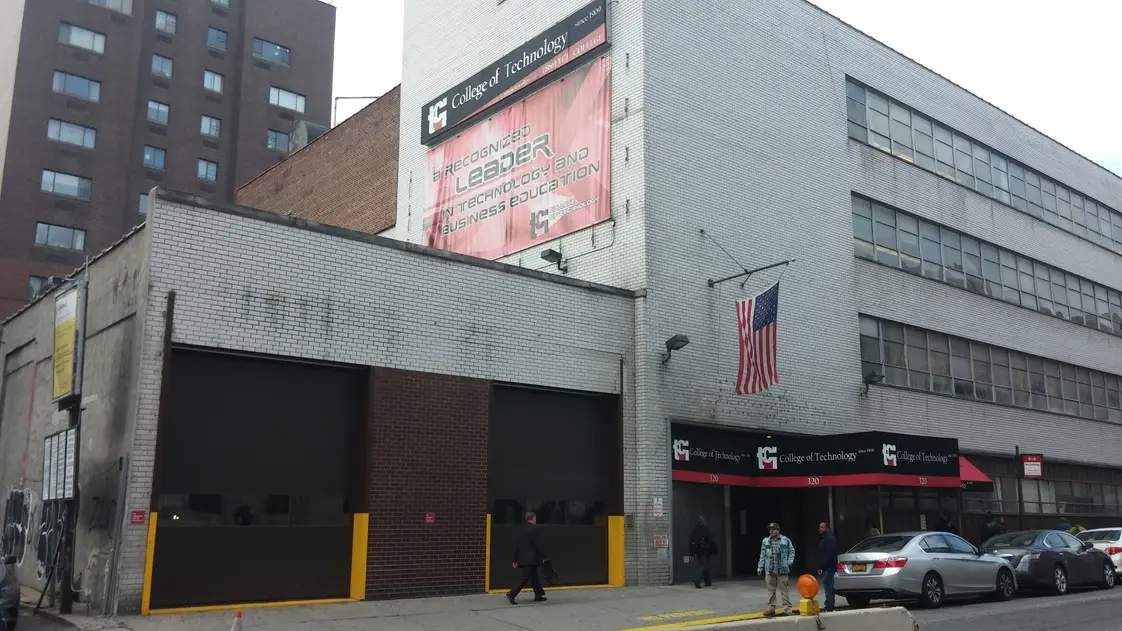
- Technical Career Institutes, also known as TCI College, was a private, for-profit college in New York City that offered two year associate degrees and certificates for education in technology, business, engineering, healthcare and other career paths.
School Highlights
Technical Career Institutes served 2,762 students (86% of students were full-time).
The college's student-teacher ratio of 25:1 was higher than the state community college average of 24:1.
Minority enrollment was 95% of the student body (majority Black), which was more than the state average of 63%.
School Overview
Technical Career Institutes
(NY) Community College Avg.
Carnegie Classification
Associates Colleges
Associate's Colleges
Institution Level
Less than 2 yrs
At least 2 but less than 4 years
Institution Control
Private, for profit
Private not-for-profit
Year Founded
1909
Total Faculty
110 staff
43 staff
Student Body
Total Enrollment
2,762 students
953 students
Student-Teacher Ratio
25:1
24:1
# Full-Time Students
2,385 students
528 students
# Part-Time Students
377 students
425 students
# Enrollment Undergraduate
2,385 students
717 students
# Full-Time Undergraduate Students
2,385 students
511 students
% Asian
5%
8%
% Hispanic
33%
23%
% Black
43%
19%
% White
5%
37%
% Non Resident races
1%
3%
% Unknown races
13%
7%
Diversity Score
0.68
0.76
College Completion Rate (Students who graduate in less than 4 years)
22%
27%
Average Graduate Earnings (10 Years)
$36,800
$35,300
Tuition & Financial Aid
Private State Tuition Fees
$13,540
$16,823
Tuition Notes
No cost to apply at
% Students Receiving Some Financial Aid
97%
92%
Median Debt for Graduates
$18,937
$12,674
Median Debt for Dropouts
$5,500
$5,523
Source: 2016 (or latest year available) Integrated Postsecondary Education Data System (IPEDS) , School Administrators
School Notes
- TCI is a degree-granting college committed to educating men and women interested in careers and further academic opportunities in Electronics and Computer Technologies, Accounting, office and new Media technologies and Climate Control and Building Maintenance technologies. Since its founding in 1909, TCI has achieved a reputation for excellence in technological education. Under the leadership of Nobel Prize recipient and founder Guglielmo Marconi, the Marconi Institute becomes a leading center for education and development in the communications industry. In 1919 its name changes to RCA Institutes. In 1974 the College's name is changed to Technical Career Institutes. Today TCI College serves more than 3,000 students through programs that focus on emerging technological fields. We collaborate closely with major New York City employers to develop programs that prepare students for the needs of today's business environment. TCI is accredited by the Middle States Commission on Higher Education, an institutional accrediting agency recognized by the U.S. Secretary of Education and the Council for Higher Education Accreditation. TCI is accredited by the New York State Board of Regents and Commissioner of Education as well as Middle States Commission on Higher Education** which accredits NYS Colleges & Universities. For more information about our graduation rates, the median debt of students who completed the program, and other important information, please visit our website at, http://www.edufficient.com/tci-disclosure/
Frequently Asked Questions
How much does Technical Career Institutes cost?
Technical Career Institutes's private state tuition is approximately $13,540.
Nearby Schools
The nearest community college to Technical Career Institutes is Mount Sinai Phillips School of Nursing (0.0 miles away)
School
Location
Miles
Quick Facts
Mount Sinai Phillips School of Nursing
Private not-for-profit
148 East 126th Street
New York, NY 10035
(212) 614-6114
New York, NY 10035
(212) 614-6114
- miles
Enrollment: 311 students Student-teacher ratio: 11:1 Acceptance rate: 67% Private-state tuition: $22,280 Minority enrollment: 64%
227 W 27th St
New York, NY 10001
(212) 217-7999
New York, NY 10001
(212) 217-7999
0.2 miles
Enrollment: 8,206 students Student-teacher ratio: 18:1 Acceptance rate: 60% In-state tuition: $5,200 Out-state tuition: $14,200 Minority enrollment: 62%
Ace Institute of Technology
Private for-profit
312 West 36 Street, 2nd Floor
New York, NY 10018
(212) 695-9700
New York, NY 10018
(212) 695-9700
0.3 miles
Enrollment: 275 students Student-teacher ratio: 39:1 Minority enrollment: 96%
Globe Institute of Technology
Private, for profit
500 7th Ave
New York, NY 10018
(212) 349-4330
New York, NY 10018
(212) 349-4330
0.4 miles
Enrollment: 490 students Student-teacher ratio: 17:1 Private-state tuition: $11,120 Minority enrollment: 92%

151 West 26th Street
New York, NY 10001
(212) 924-5900
New York, NY 10001
(212) 924-5900
0.4 miles
Enrollment: 1,233 students Student-teacher ratio: 14:1 Acceptance rate: 90% In-state tuition: $11,995 Out-state tuition: $11,995 Minority enrollment: 96%
Recent Articles

Can Your Two-Year Degree Really Be Finished in Four Semesters?
Learn how to test whether a two-year community college degree can actually be completed in four semesters by checking prerequisites, course rotations, availability, sequencing, and hidden scheduling barriers.

Program Seat Test: Are You Really Admitted to Your Major?
Learn how to determine whether community college acceptance includes admission to your intended major, and evaluate selective programs, prerequisites, seat limits, deadlines, waitlists, and backup options before enrolling.

Build Your Community College First-Semester Stress Test
Build a realistic first-semester stress test before registration by checking course load, work hours, commuting, finances, family duties, study time, and support systems before your schedule becomes unmanageable later.