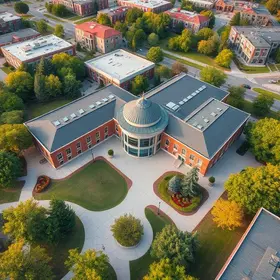
- The mission of Columbus Technical College is to foster economic growth and development and to enhance the quality of life for the citizens in its region.
School Highlights
Columbus Technical College serves 3,307 students (28% of students are full-time).
The college's student-teacher ratio of 26:1 is lower than the state community college average of 29:1.
Minority enrollment is 70% of the student body (majority Black), which is more than the state average of 62%.
Quick Facts (2026-27)
- Enrollment: 3,307 students
- In-state tuition: $2,496
- Out-state tuition: $4,440
- Student-teacher ratio: 26:1
- Minority enrollment: 70%
- Source: Verified school update
Top Rankings
Columbus Technical College ranks among the top 20% of public schools in Georgia for:
Category
Attribute
Affordability
Debt For Students
School Overview
The teacher population of 126 teachers has grown by 5% over five years.
Columbus Technical College
(GA) Community College Avg.
Carnegie Classification
Associate's Colleges
Associate's Colleges: High Career & Technical-Mixed Traditional/Nontraditional
Institution Level
At least 2 but less than 4 years
At least 2 but less than 4 years
Institution Control
Public
Public
Year Founded
1961
Total Faculty
126 staff
88 staff
School Calendar
Student Body
The student population of Columbus Technical College has grown by 10% over five years.
The student-teacher ratio of 26:1 has decreased from 30:1 over five years.
The Columbus Technical College diversity score of 0.62 is more than the state average of 0.00. The school's diversity has stayed relatively flat over five years.
Total Enrollment
3,307 students
1,835 students
Student-Teacher Ratio
26:1
29:1
# Full-Time Students
917 students
797 students
# Part-Time Students
2,390 students
1,381 students
# Enrollment Undergraduate
3,307 students
1,758 students
# Full-Time Undergraduate Students
917 students
855 students
# Part-Time Undergraduate Students
2,390 students
1,678 students
% Asian
1%
4%
% Hispanic
9%
11%
% Black
53%
35%
% White
30%
38%
% Two or more races
5%
3%
Diversity Score
0.62
0.00
College Completion Rate (Students who graduate in less than 4 years)
23%
43%
Average Graduate Earnings (10 Years)
$28,600
$29,500
Tuition & Financial Aid
The public in-state tuition of $2,496 is less than the state average of $3,346. The in-state tuition has declined by 17% over four years.
The public out-state tuition of $4,440 is less than the state average of $6,958. The out-state tuition has declined by 18% over four years.
In-State Tuition Fees
$2,496
$3,346
Out-State Tuition Fees
$4,440
$6,958
% Students Receiving Some Financial Aid
84%
91%
Median Debt for Graduates
$8,126
$12,069
Median Debt for Dropouts
$5,288
$5,500
Source: 2025 (or latest year available) Integrated Postsecondary Education Data System (IPEDS) , School Administrators
School Notes
- What was known as the Columbus Area Vocational-Technical School began classes on December 1, 1961, with 7 instructors and 39 students in a total of 8 technical or trade courses. The school was operated as a unit of the Muscogee County School District. In July of 1966, the Columbus Area Vocational-Technical School and the Muscogee Area Vocational-Technical School were combined under the name of Columbus Area Vocational-Technical School (Columbus Tech). A $500,000 expansion to the facility on 45th Street was completed in July 1967 making it possible to offer four new courses. Columbus Tech became affiliated with the Southern Association of Colleges and Schools in 1970 and was accredited December 12, 1972. Program offerings have continue to expand and now include 12 Associate Degree programs, 28 Diploma programs and 56 Technical Certificate of Credit programs. Associate Degree programs are offered in Accounting, Administrative Office Technology, Associate Degree in Nursing (ADN), Dental Hygiene, Early Childhood Care and Education, Electronics and Computer Engineering Technology, Environmental Horticulture, Management and Supervisory Development, Paramedic Technology, Radiologic Technology, Secretarial Science, and Surgical Technology. Columbus Technical College has the responsibility of producing a more highly trained workforce. We do so by maintaining constant contact with leaders of business and industry to ensure that the training we provide will make the workforce in Columbus and the surrounding region competitive in a global market. The College is committed to its mission of workforce development and meeting the needs of our business and industry. Library - Media Services is located adjacent to Patrick Hall on the second floor. Materials in addition to books include periodicals, computers with Internet access, microform readers and printers, newspapers, computer software, and videotapes. Services include student orientation to the library, computerized circulation, computer searches online and via CD ROM, transmitting and receiving documents via fax, and interlibrary loan. Columbus Technical College is accredited by the Commission on Colleges of the Southern Association of Colleges and Schools to award Associate in Applied Technology degrees. Initial accreditation was granted in 1990, with reaffirmation of accreditation granted in 1995.
Frequently Asked Questions
How much does Columbus Technical College cost?
Columbus Technical College's tuition is approximately $2,496 for In-State students and $4,440 for Out-State students.
What is Columbus Technical College's ranking?
Columbus Technical College ranks among the top 20% of community college in Georgia for: Least expensive tuition and Least debt for graduating students.
Recent Articles

Online vs. Hybrid vs. HyFlex: Understanding Community College Course Formats
Learn what online, hybrid, HyFlex, synchronous, and asynchronous course labels really mean at community colleges, including attendance, meeting, testing, and participation requirements students should verify before registering today.

Working Student Schedule Test: Night and Online Community College Programs
Learn how working students can test whether a community college program is truly available at night or online, including labs, prerequisites, exams, internships, advising, and course rotations.

Is the Employer Advisory Board Real or Ceremonial?
Learn how to evaluate a community college employer advisory board, verify industry participation, identify meaningful employer influence, and determine whether career connections can benefit students after graduation today.