For many students, choosing a community college starts with comparing tuition rates. While tuition is certainly important, it is often not the largest factor affecting the true cost of attending college.
Transportation expenses, parking fees, fuel costs, vehicle maintenance, public transit fares, and lost time can add thousands of dollars to the cost of earning a degree or certificate. In some cases, a college with slightly higher tuition may actually be the more affordable option once commuting expenses are considered.
This is why prospective students should apply what might be called the "Total Commute Cost" test before making a final enrollment decision.
By evaluating both direct and indirect commuting expenses, students can make more informed choices about where to attend and how to complete their education as efficiently as possible.
The Hidden Cost of Distance
Students often focus on sticker price when comparing colleges. However, the college with the lowest tuition is not always the least expensive overall.
Consider two community colleges:
| College | Annual Tuition | Round-Trip Commute | Estimated Annual Commute Cost |
|---|---|---|---|
| College A | $4,000 | 12 miles | $800 |
| College B | $3,500 | 60 miles | $3,200 |
At first glance, College B appears to save $500 annually. But transportation costs can quickly erase those savings.
A student driving 60 miles each day for classes may spend substantially more on fuel, maintenance, tires, parking, and vehicle depreciation than a student attending the closer campus.
Over the course of a year, the lower-cost college may actually become the more expensive option.
Why Commuting Costs Matter More Than Ever
Community colleges serve a large population of commuting students. Unlike many residential universities, most community college students travel from home to campus multiple times each week.
According to the National Center for Education Statistics, community colleges enroll millions of students nationwide, many of whom balance education with work and family responsibilities.
For these students, transportation costs are not simply a budgeting issue. They directly affect academic success, scheduling flexibility, and overall quality of life.
Longer commutes can increase stress, reduce study time, and make it harder to participate in tutoring, advising, and campus activities. Community College Review's analysis of transportation challenges for community college students examines how travel barriers can affect both attendance and completion rates.
Calculating Your Total Commute Cost
The first step is identifying all transportation-related expenses associated with attending a particular college.
Many students think only about gasoline. In reality, commuting involves several categories of costs:
| Expense Category | Examples |
|---|---|
| Transportation | Fuel, transit fares, rideshare costs |
| Vehicle Wear | Tires, maintenance, repairs |
| Parking | Campus permits and daily fees |
| Time | Lost work hours and study time |
| Opportunity Costs | Reduced access to campus resources |
Even modest commuting expenses accumulate quickly over multiple semesters.
For students considering multiple institutions, comparing transportation costs should be just as important as comparing tuition rates.
The Value of Time Is Often Overlooked
The most expensive part of commuting may not be transportation itself.
It may be time.
A student who spends two hours commuting every day sacrifices hundreds of hours annually that could otherwise be used for studying, working, participating in internships, or meeting with faculty.
Those hours have real value.
For example, a student working part-time at $18 per hour who loses five hours per week to additional commuting effectively gives up nearly $4,000 worth of earning potential over a typical academic year.
When viewed through that lens, shorter commutes can become a significant financial advantage.
Students comparing schools should evaluate several factors beyond tuition. Community College Review's guide to choosing the right community college explores additional considerations that influence long-term student success.
Online and Hybrid Courses Can Change the Equation
One reason community colleges have expanded online learning options is to provide greater flexibility for students with work and family obligations.
A partially online schedule can dramatically reduce transportation costs.
For example, a student who attends campus two days per week instead of five may reduce annual commuting expenses by more than half.
Community College Review's comparison of online vs. on-campus community college programs explains how different course formats can affect both educational costs and scheduling flexibility.
When comparing colleges, students should investigate course delivery options alongside tuition and fees.
Transportation Access Should Influence College Selection
Not every student owns a vehicle.
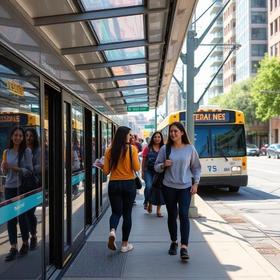
Many community college students rely on public transportation, carpools, cycling, or walking.
Before enrolling, students should evaluate transit routes, parking availability, travel times, and overall reliability.
The U.S. Department of Transportation provides data and resources that illustrate how transportation infrastructure influences access to education and employment opportunities.
A college located near major transit routes may ultimately be more practical than one requiring extensive daily driving.
How Commute Costs Affect Student Success
Research consistently shows that logistical challenges can influence persistence and completion rates.
Students facing lengthy commutes often encounter additional barriers when unexpected circumstances arise. Traffic delays, vehicle repairs, weather conditions, and family responsibilities can become more disruptive when students travel long distances to reach campus.
This is one reason many institutions have expanded support services and flexible scheduling options. Community College Review's examination of student success programs that actually work at community colleges highlights how colleges are helping students overcome barriers that can interfere with completion.
The easier it is to consistently attend class and access campus resources, the more likely students are to stay on track toward graduation.
Don't Ignore the Hidden Costs
Many prospective students compare tuition and little else.
However, transportation expenses often belong to a larger category of overlooked educational costs. Books, supplies, technology requirements, parking permits, and commuting expenses can significantly increase the true cost of attendance.
Community College Review's guide to hidden costs of community college provides a broader look at expenses that students frequently underestimate during the college selection process.
Looking at total costs rather than tuition alone often leads to better financial decisions.
The Bottom Line
Choosing a community college involves much more than comparing tuition figures.
Transportation expenses, commuting time, parking costs, and scheduling flexibility all contribute to the true cost of attendance. In some cases, a nearby college with slightly higher tuition may be significantly less expensive once commuting expenses are factored into the equation.
The "Total Commute Cost" test encourages students to evaluate education decisions through a broader financial lens. By considering both direct costs and opportunity costs, prospective students can identify the college that delivers the greatest overall value.
A smart college choice is not necessarily the cheapest option on paper. It is the option that best balances affordability, accessibility, academic quality, and long-term success.