
Updated
|
Underprivileged Student?  Upward Bound Can Prepare You for College
We take a closer look at the Upward Bound program, which is designed to prepare students for college whom might not otherwise succeed due to economic or family factors.

Prospective college students that come from families where many have already forged the path through higher education have many resources at their disposal when it comes time to head to the college of their choice. In contrast, those who will be the first in their family to attend college do not have the same advantage of experience within the family to light the way. For those students, programs like Trio Upward Bound help them to understand what higher education is about and find the path through a college education that will benefit them most in the future. To that end, community colleges across the country offer Upward Bound programs to motivate students to explore higher education and determine the college path they want to take.

This video looks at the Harvey Mudd College Upward Bound program.

History of Trio Upward Bound

The origins of Upward Bound date back to the Educational Opportunity Act, which was signed into law by President Lyndon B. Johnson in 1964. According to the Council for Opportunity in Education, the experimental program was first introduced to reduce barriers faced by low-income and first-generation college students that created inequality in educational opportunities for those students. The program is offered through colleges, universities, and community colleges, and funds are distributed to individual programs through the issuance of competitive grants.

Upward Bound is just one of three programs that

. . .read more

10 Tips For Successful Community College Transfers

Updated
|
10 Tips For Successful Community College Transfers
Utilize our advice and practical tips for students interested in transferring community college credits to a four-year university.

10 Tips For Successful Community College Transfers

Transferring from a community college to a four-year institution can be a strategic step toward achieving your academic goals. Here are ten essential tips to ensure a smooth and successful transfer journey.

1. Explore Articulation Agreements

Articulation agreements are formal partnerships between community colleges and four-year universities that outline transferable courses and admission requirements. These agreements can simplify the transfer process and provide a clear academic pathway.

Key Points:

  • Guarantee credit transfer for specific courses.

  • May offer guaranteed admission if the criteria are met.

  • Provide a roadmap for course selection.

This video explains how to transfer from a community college to a four-year institution.

2. Identify Your Academic Interests Early

Utilize your time at community college to explore various fields of study. Determining your major early can help in selecting appropriate courses that align with your intended bachelor's program.

Benefits:

    . . .read more

    Why are Universities Turning to a Reverse Transfer System?

    Updated
    |
    Why are Universities Turning to a Reverse Transfer System?
    The reverse transfer is growing exponentially in popularity. This is a more and more common new policy among many institutions to allow transfer of credits from four-year universities to community colleges. Why is it done, and who benefits from the policy?

    Many community colleges across the country have transfer agreements with four-year schools, which allow students to easily transfer credits from the community college level and apply them toward a four-year degree program. Now, a whole new type of program is cropping up among two and four-year schools from coast to coast. Instead of transferring credits from community colleges to universities, schools are now allowing agreeing to reverse transfers, which allow students to take credits from their four-year institution and apply them to their community college degree.

    The Reverse Transfer System is Introduced

    While transfers to four-year schools provide clear benefits and a subsequent rise in popularity, the assurance of transferring credits from the university level to the local community college creates a more complex array of advantages. This process is a relatively new one that is just beginning to be introduced in college systems nationwide.

    Many students who begin their college work at a community college move to a four-year institution before completing their associate degree. While credits may transfer to the four-year school, the student is left without a degree to underscore the work they put into their first college efforts. Until the bachelor’s degree is finished – which may take many more years of education – the student has little to show for his time, effort and money.

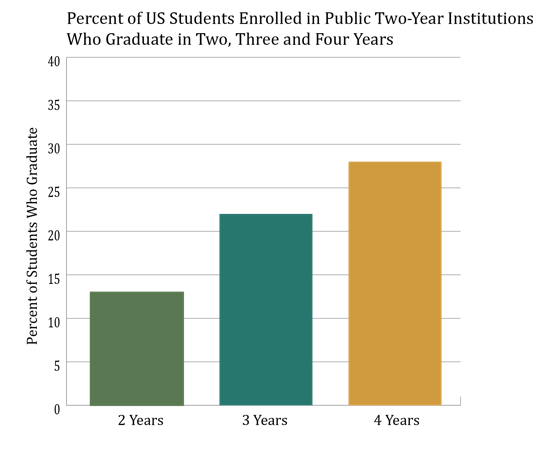
    At the same time, community colleges are forced to report dismal completion rates – in some cases possibly affecting their ability to receive funding.

    . . .read more

    Land One of the Fastest Growing Jobs with a Community College Degree

    Updated
    |
    Land One of the Fastest Growing Jobs with a Community College Degree
    Are you looking for your career path? Consider some of the jobs boasting the fastest job growth today that only need a community college degree.

    Despite laments nationwide over the sluggish economy and high unemployment rates, some fields are booming for community college graduates today. With decent starting salaries and higher-than-average growth predictions, many of these fields are the perfect professions for higher education students to focus their studies. Many of the fastest-growing jobs on the latest list can be entered with an associate degree, giving graduates the best possible value for their education dollars.

    Home Health Aides

    Home health aides come into homes to help those who are disabled, ill, or elderly. These professionals provide various services, from personal hygiene to light housekeeping. In some states, aides can administer medication or take vital signs. The home health aide role is imperative to those who want to be at home but cannot care for themselves ultimately. Although most visit patient homes, some work in group homes or care centers.

    According to the Bureau of Labor Statistics, the average annual salary for a home health aide was $20,560 in 2010. The job opportunities are expected to grow by 69.4 percent between 2010 and 2020, well ahead of the national average for job growth. This profession typically does not require postsecondary education, although a two-year degree at a community college may increase employment prospects.

    Veterinarian Technicians

    Those with a passion for four-legged patients may find their niche as veterinary technicians or technologists. These professionals work alongside veterinarians, performing diagnostic testing and assisting with the treatment of animals of all kinds.

    . . .read more

    Remedial Education Leaves Many Colleges in a Quandary

    Updated
    |
    Remedial Education Leaves Many Colleges in a Quandary
    Although many students need some remedial education before beginning college coursework, statistics show dismal completion rates for those who begin in remedial classes. We take a closer look at the problem, as well as some of the ways colleges are tackling it.

    Remedial education is a core component of community colleges today, as more students enter the world of higher education unprepared for the rigors of a college-level curriculum. However, remedial education has been linked to a low completion rate at some schools, where hours of class time in unrelated, remedial courses interfere with a student’s ability to earn a degree in a reasonable amount of time. With many factors weighing on a college’s ability to offer efficient remedial education, some schools are taking innovative approaches to the idea of preparing students for the rigors of higher education.

    This video looks at the issue of remedial courses in community college.

    The Prevalence of Remedial Education

    An article at the Hartford Courant suggests that too many incoming freshmen are getting placed in remedial classes before they can take actual college coursework. The Courant reports that as many as 60 percent of all students entering community college must take at least one refresher course in math or English. What is even more unsettling is that only about one-quarter of these students go on to actually complete their degree program.

    The publication also cites statistics from the Community College Research Center that show one-third of these students could pass a regular college course with a grade of a “B” or better, even without the remedial coursework under their belts. These numbers certainly seem to suggest that students are getting placed in remedial classes more often than is necessary.

    . . .read more

    Recent Articles

    5 Key Community College Trends Parents Should Know in 2026
    5 Key Community College Trends Parents Should Know in 2026
    Explore major 2026 community college trends including enrollment changes, costs, career programs, and affordability for parents planning college decisions.
    Average Community College Tuition Cost 2026 Update
    Average Community College Tuition Cost 2026 Update
    Explore updated 2026 community college tuition averages, cost trends, planning tips, admissions timing advice, and financial strategies for families and students.
    Preparing for Placement Tests in 2026: Student Guide
    Preparing for Placement Tests in 2026: Student Guide
    Preparing for Placement Tests in 2026, what students, parents, and educators need to know about formats, prep strategies, and placement changes.