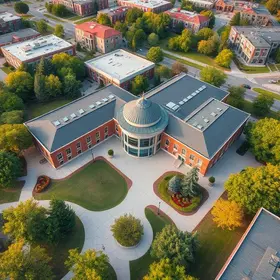
College of the Desert

43-500 Monterey Ave
Palm Desert, CA 92260
Top-Ranked (2026-27): View Rankings
  • COD is a two-year, public institution that provides lower division academic, vocational, and basic skills education. We are a successful college because we make decisions based on a systematic assessment of the needs of the community and the application of our core values.

School Highlights

College of the Desert serves 12,861 students (33% of students are full-time).
The college's student-teacher ratio of 47:1 is higher than the state community college average of 44:1.
Minority enrollment is 82% of the student body (majority Hispanic), which is more than the state average of 77%.

Quick Facts (26-27)

  • Enrollment: 12,861 students
  • In-state tuition: $1,316
  • Out-state tuition: $6,832
  • Student-teacher ratio: 47:1
  • Minority enrollment: 82%
  • Source: Integrated Postsecondary Education Data System (IPEDS)

Top Rankings

College of the Desert ranks among the top 20% of public schools in California for:

Category
Attribute
Community Size

School Overview

The teacher population of 274 teachers has declined by 54% over five years.
College of the Desert
(CA) Community College Avg.
Carnegie Classification
Associate's Colleges
Associate's Colleges: High Transfer-Mixed Traditional/Nontraditional
Institution Level
At least 2 but less than 4 years
Institution Control
Public
Public
Year Founded
1958
Total Faculty
274 staff
72 staff
School Calendar

Student Body

The student population of College of the Desert has grown by 17% over five years.
The student-teacher ratio of 47:1 has increased from 20:1 over five years.
The College of the Desert diversity score of 0.45 is less than the state average of 0.71. The school's diversity has stayed relatively flat over five years.
Total Enrollment
12,861 students
6,838 students

Showing 2012–2025. Full 19-year historical data available below ↓

Student-Teacher Ratio
47:1
44:1
# Full-Time Students
4,187 students
1,022 students

Showing 2012–2025. Full 19-year historical data available below ↓

# Part-Time Students
8,674 students
5,816 students

Showing 2012–2025. Full 19-year historical data available below ↓

# Enrollment Undergraduate
12,861 students
2,055 students
# Full-Time Undergraduate Students
4,187 students
967 students

Showing 2013–2025. Full 19-year historical data available below ↓

# Part-Time Undergraduate Students
8,674 students
5,850 students
% Asian
3%
12%

Showing 2008–2025. Full 19-year historical data available below ↓

% Hispanic
72%
46%

Showing 2008–2025. Full 19-year historical data available below ↓

% Black
3%
7%

Showing 2008–2025. Full 19-year historical data available below ↓

% White
18%
23%

Showing 2010–2025. Full 19-year historical data available below ↓

% Two or more races
3%
5%
% Non Resident races
1%
1%
Diversity Score
0.45
0.71

Showing 2011–2025. Full 19-year historical data available below ↓

College Completion Rate (Students who graduate in less than 4 years)
27%
42%

Showing 2015–2025. Full 19-year historical data available below ↓

Average Graduate Earnings (10 Years)
$34,600
$34,300

Tuition & Financial Aid

The public in-state tuition of $1,316 is more than the state average of $1,238. The in-state tuition has stayed relatively flat over four years.
The public out-state tuition of $6,832 is more than the state average of $6,634. The out-state tuition has declined by 23% over four years.
In-State Tuition Fees
$1,316
$1,238
Out-State Tuition Fees
$6,832
$6,634
% Students Receiving Some Financial Aid
88%
85%

Showing 2012–2025. Full 19-year historical data available below ↓

Median Debt for Graduates
$5,500
$9,500
Median Debt for Dropouts
$4,979
$6,272
Source: 2025 (or latest year available) Integrated Postsecondary Education Data System (IPEDS)

School Notes

  • College of the Desert offers two types of academic tracks; (1) lower division transfer courses required for most majors and professions at four-year universities or colleges and, (2) a wide variety of curricular offerings designed to meet the needs of those preparing for immediate employment, for those who are currently employed and need to upgrade their skills, or for those who are interested in a job retraining program and personal development. The Center for Training and Development provides a variety of unique programs and services designed to assist in the growth and stability of both area businesses and the College itself. The Walter N. Marks Center for the Arts is a nonprofit cultural and educational facility located on College of the Desert's campus. Committed to educational excellence, The Marks Center provides a venue for artistic exploration, experimentation and research. Traditional formats of painting, drawing, sculpture ceramics, photography and printmaking are complemented by contemporary applications in papermaking, book arts, performance and installation arts. College of the Desert is accredited by the Accrediting Commission for Community and Junior Colleges of the Western Association of Schools and Colleges, an institutional accrediting body recognized by the Council for Higher Education Accreditation and the U.S. Department of Education.

Frequently Asked Questions

How much does College of the Desert cost?
College of the Desert's tuition is approximately $1,316 for In-State students and $6,832 for Out-State students.
What is College of the Desert's ranking?
College of the Desert ranks among the top 20% of community college in California for: Largest student body.

Recent Articles

Required Course Full? Avoid Community College Degree Delays
Learn how a full required course can delay graduation, how to navigate waitlists, and how to find approved alternatives that protect your community college degree timeline and financial aid eligibility.
Catalog-Year Rules: Community College Graduation Requirements
Understand how catalog years determine community college graduation requirements, how enrollment breaks and major changes affect eligibility, and what to verify before choosing courses or switching to a newer catalog.
What If Your Community College Program Closes?
Learn what happens when your community college discontinues your program before graduation, including teach-out options, credit transfers, financial aid implications, student protections, and practical steps to finish your degree successfully.

Quick Facts (26-27)

  • Enrollment: 12,861 students
  • In-state tuition: $1,316
  • Out-state tuition: $6,832
  • Student-teacher ratio: 47:1
  • Minority enrollment: 82%
  • Source: Integrated Postsecondary Education Data System (IPEDS)

Related School Videos

Did You Know?

Riverside County, CA community colleges have a diversity score of 0.56, which is lower than the national average of 0.74. The most diverse community college in Riverside County, CA is Young Americans College of the Performing Arts. Read more about community college diversity statistics in the USA.

Quick Links