
2015-2020

Sports at Community College: Spring 2017 Trends

Updated
|
Sports at Community College: Spring 2017 Trends
Community colleges are not generally known for their athletics programs, but some schools do offer opportunities for student-athletes. In fact, it has been a trending topic this week in March 2017.

Many students choose community college over a traditional four-year university because it is more affordable. A year of tuition at community college could be as low as $3,500 compared to more than $33,000 for a private university. But just because community college is more affordable doesn’t necessarily mean it is any less a real college. Many community colleges strive to mimic the “true” college experience by offering their students campus housing and social activities.

Another way in which community colleges strive to compete with traditional universities is by offering athletics programs. In early March of 2017, community college athletics was a trending topic on Twitter, Instagram, and other social media. Keep reading to learn more.

Students Choose Community Colleges for Sports

In early March 2017, the Twitter hashtag #communitycollege was filled with announcements by incoming community college students making commitments based on athletics. Here is an overview of some of those announcements:

  • On March 2, 2017, @jvaught11, the Twitter handle, posted, “Excited to announce that I have signed to play baseball at Chandler-Gilbert Community College.” Home of the Wild Coyotes, Chandler-Gilbert Community College is located in Chandler, Arizona, and it offers a variety of sports programs, including baseball, basketball, golf, soccer, softball, and volleyball.
  • On March 8, 2017, the Twitter handle @CoachRegalado posted, “Congrats to @mgonzalez13 on her visit and PWO offer to Laredo Community College!” Laredo Community College, also known as LCC, is located in Laredo, Texas, and offers sports programs, including baseball, softball,
. . .read more

Why Four Year Community College Degrees May Be Great for California

Updated
|
Why Four Year Community College Degrees May Be Great for California
Recently, a measure passed that allows community colleges in California to offer 4 year degrees. Until now such offerings have been the sole province of other institutions. Now, the game has changed.

There’s a change coming in California.

Recently, a measure passed that allows community colleges in California to offer four-year degrees. Until now, such offerings have been the sole province of other institutions. Now, the game has changed.

On September 28, 2014, California Governor Jerry Brown signed Senate Bill 850 (Block), authorizing up to 15 California community college districts to offer a single Bachelor's degree on a pilot basis. The bill's goal is to create one million bachelor' s-degree jobs by 2025.

California Community Colleges Four Year 2

A Better College System

Former California State Senator Dean Florez says this measure is a decisive move in the right direction. “Allowing California Community colleges to offer four year skill-based degrees has grown from a long-simmering recognition—from students, employers and government leaders—that skills matter more today than how and where they were acquired. This new four-year program offers students a more accessible and shorter education pathway with a recognized skill-based credential.”

“Students benefit with a tailored personalized degree program directed in part by employers, blending their career needs with an affordable degree. It is also very cost effective, given the planned BA degrees will be under $10,000 dollars, which is nearly one-half the cost of California State's four year schools and one-eighth the cost of a traditional University of California four-year degree. Most community college students can't afford to give up four or five years of income while accumulating six-figure debt, so this degree

. . .read more

Free Community College Coming Soon? President Obama Hopes So

Updated
|
Free Community College Coming Soon? President Obama Hopes So
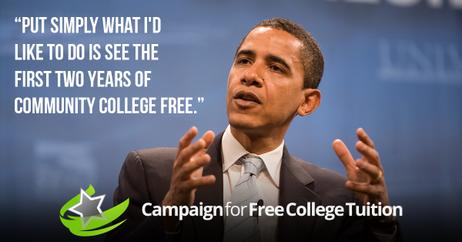
Earlier this year, President Obama outlined a proposal that would make community college free for millions of community college students. What does it mean for you?

So you want to go to college but can’t afford it. Perhaps you don’t want to take out loans that will take decades to pay off. Or maybe you don’t think you’d get many (or any) scholarships or grants because your grades are good enough but not that great or because you make just enough money not to be considered in great financial need.

If the President has his way, none of this will matter.

In January, in his State of the Union Address, President Obama outlined a $60 billion plan to make community college free for everyone. While ‘everyone’ doesn’t actually mean everyone, the plan would still open many doors for students who may not otherwise be able to attend college.

What are the Criteria?

The criteria for a tuition-free community college under the Obama plan are straightforward. Students must maintain a 2.5 GPA, which leads to a smattering of Bs and Cs – grades that most students quickly achieve. Attendance must be at least half-time, which is typically considered to be six or more credit hours each semester. That’s just two classes per semester, which is easily achievable by most students, even those who work or have other obligations outside of school. In short, students who put in the effort would get a free education.

There is, however, a third criterion. To limit the program's long-term costs, the plan would be

. . .read more

Four-Year Degrees at Community College? Many Schools Now Say Yes

Updated
|
Four-Year Degrees at Community College? Many Schools Now Say Yes
What is the latest on four-year degree programs at community colleges? We look at some of the states entering into this relatively new frontier, and why some are having a tough time selling the idea.

Community colleges have traditionally been considered the go-to place for two-year vocational degrees or general college coursework for students that have plans to transfer to a four-year college or university. However, these institutions of higher education are increasing their program offerings to include a smattering of four-year degree options as well. Although not without their share of opposition, the four-year degree is slowly but surely becoming more common at the community college level. Check out these states and schools delving into the frontier of the four-year degree program.

Chattanooga State Considers Addition of Five Four-Year Programs

A community college in Tennessee is looking at adding five new programs to their current catalog selections. The Chattanoogan reports that Chattanooga State Community College is considering the addition of four-year degree programs in a variety of high-tech fields. The president of the college, Dr. Jim Cantanzaro, applied for approval of the programs last summer and is still waiting for a response from the Tennessee Board of Regents.

The community college would like to add four-year degree programs in chemical process engineering, radiological sciences, nuclear engineering, technology management, and mechatronics engineering. The programs were specifically chosen based on the local employment needs of the current workforce. Dr. Cantanzaro made it clear the goal of the program addition was to fulfill those professional needs and not to transform Chattanooga State into a full-fledged four-year school.

Dr. Cantanzaro also explained that 60 percent of the material in

. . .read more

Top 100 Degree-Producing Community Colleges

Updated
|
Top 100 Degree-Producing Community Colleges
Which community colleges produce the greatest number of degrees? We analyze a report that details the top producing community colleges across the country.

Community colleges have become the main focus of higher education in recent years, as the United States strives to fill the workforce needs of the 21st century. Completion rates for community colleges are more important than ever before, as students must complete their training programs to become productive members of the global marketplace. To help prospective students locate the community colleges with the greatest odds of success, Community College Week releases annual analyses of the community colleges that produce the most associate degrees each academic year.

About the Analysis

The National Center for Education Statistics collects the annual Top 100 Analysis data. The list includes associate degrees earned during the 2010-2011 school year, with total degrees earned and breakdowns according to race. The breakdowns were handled by a two-question format students were asked to answer, according to the website for Community College Week. Students were first asked if they were of Hispanic or Latino heritage. Then, they were asked to check off various races that applied to them, including African American, Native American, and Asian American.

This year’s analysis found record increases in the number of associate degrees earned over the past three years. As associate degrees appear to be on the rise, certificate programs, which can usually be earned in less than two years, seem to be on the decline. It is also interesting to note that the number of associate degrees earned at public community colleges was just 61 percent. Proprietary institutions

. . .read more

Recent Articles

Student Success Programs That Actually Work at Community Colleges
Discover evidence-based student success programs at community colleges for 2025, with outcomes, examples, and actionable strategies.
Best Community Colleges by Career Path in 2025
Explore top community colleges for career-training programs in 2025, including healthcare, IT, skilled trades and business pathways.
Dual Enrollment in High School: Benefits, Risks & Real Student Results
Explore the pros and cons of dual enrollment in high school, real outcomes for students in 2025, and how to decide if it’s right for you.