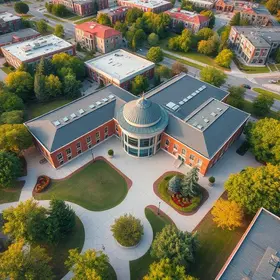
- Georgia Military College is a public-independent educational institution, comprised of a junior college and a separate preparatory school (grades 6-12), whose mission and purpose is to produce educated citizens by providing junior college students with a liberal arts based two-year undergraduate curriculum, by providing selected college students with ROTC training, and by providing preparatory school students an inclusive college preparatory curriculum that includes a military training component--all in an environment conducive to the holistic development of the intellect and character of its students.
School Highlights
Georgia Military College-Atlanta Campus serves 979 students (76% of students are full-time).
The college's student-teacher ratio of 33:1 is higher than the state community college average of 29:1.
Minority enrollment is 81% of the student body (majority Black), which is more than the state average of 62%.
Quick Facts (26-27)
- Enrollment: 979 students
- Student-teacher ratio: 33:1
- Minority enrollment: 81%
- Source: Integrated Postsecondary Education Data System (IPEDS)
School Overview
The teacher population of 30 teachers has stayed relatively flat over five years.
Georgia Military College-Atlanta Campus
(GA) Community College Avg.
Carnegie Classification
Associate of Arts Colleges
Associate's Colleges: High Career & Technical-Mixed Traditional/Nontraditional
Institution Level
Less than 2 yrs
At least 2 but less than 4 years
Institution Control
Public
Public
Year Founded
1879
Total Faculty
30 staff
88 staff
School Calendar
AccreditationAccred.
Southern Association of Colleges and Schools Commission on Colleges (SACSCOC)
Student Body
The student population of Georgia Military College-Atlanta Campus has stayed relatively flat over five years.
The student-teacher ratio of 33:1 has stayed the same over five years.
The Georgia Military College-Atlanta Campus diversity score of 0.65 is less than the state average of 0.71. The school's diversity has declined by 9% over five years.
Total Enrollment
979 students
2,178 students
Student-Teacher Ratio
33:1
29:1
# Full-Time Students
748 students
797 students
# Part-Time Students
231 students
1,381 students
# Enrollment Undergraduate
979 students
1,758 students
# Full-Time Undergraduate Students
979 students
855 students
% Hispanic
4%
11%
% Black
49%
35%
% White
19%
38%
% Two or more races
1%
3%
% Unknown races
27%
7%
Diversity Score
0.65
0.71
College Completion Rate (Students who graduate in less than 4 years)
16%
32%
Median Earnings 10 Years After Entry (measured in 2011-2012, in 2014 dollars)
$31,300
$27,350
Points are in the dollars of their own College Scorecard release, and the colleges behind the state line differ by period. The lines do not show inflation-adjusted growth.
Tuition & Financial Aid
Median Debt for Graduates
$9,187
$9,500
Median Debt for Dropouts
$3,500
$3,834
Source: 2025 (or latest year available) Integrated Postsecondary Education Data System (IPEDS) , School Administrators
Recent Articles

Fast Credential or Degree Pathway? How to Choose
Short-term training has more funding options, but speed is only one consideration. Compare immediate job preparation with documented degree pathways, remaining coursework, future costs, and realistic plans for returning.

Aerospace & Chip Programs: Should You Follow the Funding?
New investment is expanding technical training, but funding alone should not determine your major. Learn how to evaluate funded programs, student access, career fit, and benefits for your entering class.

Should You Choose a Community College Program Built Around One Major Local Employer?
A community college program tied to one major employer can offer valuable training. Learn how to weigh specialized skills, local job dependence, and your options if that employer changes course.