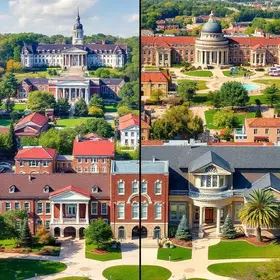
- The mission of Eastern Oklahoma State College is to generate student learning through its associate degrees and other academic programs which effectively prepare graduates to complete baccalaureate degrees, obtain productive employment, and lead enriched lives of learning. It is simultaneously the mission of the College to engage in educational programming and related activities that promote regional economic and community development.
School Highlights
Quick Facts (26-27)
- Enrollment: 1,285 students
- In-state tuition: $3,766
- Out-state tuition: $7,383
- Student-teacher ratio: 22:1
- Minority enrollment: 41%
- Source: Integrated Postsecondary Education Data System (IPEDS)
School Overview
Student Body
Showing 2012–2025. View full 19-year historical data
Showing 2008–2025. View full 19-year historical data
Showing 2012–2025. View full 19-year historical data
Showing 2012–2025. View full 19-year historical data
Showing 2013–2025. View full 19-year historical data
Showing 2011–2023. View full 17-year historical data
Showing 2008–2025. View full 19-year historical data
Showing 2008–2025. View full 19-year historical data
Showing 2010–2025. View full 19-year historical data
Showing 2011–2025. View full 19-year historical data
Showing 2015–2025. View full 19-year historical data
Points are in the dollars of their own College Scorecard release, and the colleges behind the state line differ by period. The lines do not show inflation-adjusted growth.
Tuition & Financial Aid
Showing 2013–2025. View full 19-year historical data
Showing 2008–2020. View full 14-year historical data
Showing 2008–2020. View full 14-year historical data
School Notes
- Eastern Oklahoma State College was originally established as the Oklahoma School of Mines and Metallurgy, offering degrees in mining engineering. Although closed during World War I, the school reopened in 1920 with trade and industrial education added to the curriculum. In 1924, the School of Mines added teacher training and extension courses, but, with the decline of local area mining by then well advanced, the school dropped mining engineering. Then in 1927, the school won a long overdue name change to Eastern Oklahoma State College and with the change came an added mission of pre-college level instruction. In 1941, the again renamed Eastern Oklahoma State College Agricultural and Mechanical College moved under the control of the State Board of Agriculture as a junior college. Finally, in 1972, the legislature settled on the name Eastern Oklahoma State College and created a separate board to govern the institution. Since that time, Eastern has been a comprehensive community college providing instruction in a wide range of curricula. Eastern Oklahoma State College is located at Wilburton, Oklahoma, the county seat of Latimer County, in the heart of a beautiful valley between the San Bois and Winding Stair Mountain Ranges. Forest-covered mountains, mountain streams, and nearby Robbers Cave State Park, provide a great outdoors playground for swimming, fishing, hunting, picnicking and driving the year round. In 1998, Eastern opened a state-of-the-art branch facility in McAlester, offering programs at the associate, bachelor, and graduate levels. The 22,000 square foot building offers interactive classrooms, as well as computer and science laboratories equipped with advanced technologies. Based on public demand, plans are underway for a second building dedicated to allied health programs. Additionally, Eastern offers classes at the McCurtain County Higher Education Center in Idabel. Whether your interests are in agriculture, business, computer science, criminal justice, languages, nursing, or science and math, or other liberal arts fields, Eastern has opportunities for you to explore. Eastern Oklahoma State College, a public community college, is officially accredited by the North Central Association of Colleges and Secondary Schools (since March 1954), the State Regents for Higher Education, the National League for Nursing, the Society of American Foresters, and Oklahoma State School Accrediting Agencies. Eastern's memberships include the American Association of Junior Colleges, the Council of North Central Junior Colleges, and the Oklahoma Association of Junior Colleges.
Frequently Asked Questions
How much does Eastern Oklahoma State College cost?
What schools are Eastern Oklahoma State College often compared to?
Nearby Schools
Warner, OK 74469
(918) 463-2931
Poteau, OK 74953
(918) 647-1200
Muskogee, OK 74403
(918) 687-6383
Muskogee, OK 74403
(918) 683-4581
Okmulgee, OK 74447
(918) 293-4678
Recent Articles