How to Transfer to a Four-Year University Without Losing Credits in 2026
Knowing how to transfer to a four-year university without losing credits is one of the most important concerns for today’s college students and families. In 2026, more than one third of bachelor’s degree recipients will have attended at least two institutions. Credit loss during transfer remains common, costly, and frustrating.
Understanding how to transfer to a four-year university without losing credits can save students thousands of dollars and months, sometimes years, of additional coursework. This guide explains how to transfer to a four-year university without losing credits using current policies, updated tools, and proven strategies that work in today’s higher education landscape.
Why Credit Loss Happens During College Transfers
Before learning how to transfer to a four-year university without losing credits, it helps to understand why credits are often lost. Colleges retain authority over which courses count toward their degree programs. Even accredited courses may be accepted only as electives or not at all.
Common reasons credit loss occurs include:
- Course content that does not match major requirements
- Credits earned at nationally accredited rather than regionally accredited institutions
- Lack of articulation agreements between institutions
- Changing majors after transfer
- Outdated or incomplete advising
Understanding these risks is essential when planning how to transfer to a four-year university without losing credits.
Start With Transfer-Friendly Institutions
One of the most effective ways to learn how to transfer to a four-year university without losing credits is to start at an institution designed for transfer success. Community colleges play a central role in transfer pathways, especially in 2026, as states continue expanding guaranteed transfer programs.
Many community colleges align coursework with nearby public universities through formal articulation agreements. These agreements specify which courses transfer and how they apply toward a bachelor’s degree.
Students researching how to transfer to a four-year university without losing credits should prioritize institutions with:
- Statewide articulation agreements
- Published transfer pathways
- High transfer acceptance rates
CommunityCollegeReview.com offers helpful insights into how community colleges support transfer planning through advising and partnerships.
Understand Articulation and Transfer Agreements
Articulation agreements are the backbone of how to transfer to a four-year university without losing credits. These formal contracts define how credits move from one institution to another.
There are several common types of agreements:
- Course-to-course agreements that match specific classes
- Program-to-program agreements that align entire associate degrees with bachelor’s programs
- Guaranteed admission agreements that ensure entry once requirements are met
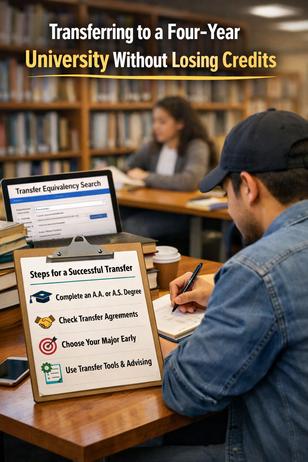
In many states, earning an Associate of Arts or Associate of Science degree under a transfer agreement guarantees that general education requirements will transfer in full. This is one of the most reliable methods for how to transfer to a four-year university without losing credits.
The U.S. Department of Education highlights the importance of transfer pathways and articulation agreements in reducing credit loss nationwide.
Choose the Right Degree Path Early
Choosing the correct associate degree is a critical step in how to transfer to a four-year university without losing credits. Not all associate degrees are created equal.
Transfer-focused degrees typically include:
- Associate of Arts
- Associate of Science
- Associate of Arts for Transfer, in applicable states
Career-focused degrees, such as Associate of Applied Science programs, are often designed for immediate employment. While some credits may transfer, these degrees are not optimized for how to transfer to a four-year university without losing credits.
Students should confirm that their degree plan aligns with a specific major at the target university.
Align Your Major Before You Transfer
One of the biggest mistakes students make when learning how to transfer to a four-year university without losing credits is waiting too long to choose a major. Major-specific coursework often has strict sequencing.
For example, engineering, nursing, and science majors typically require specific math and lab courses that must transfer exactly. Taking the wrong version of calculus or chemistry can delay graduation.
To improve how to transfer to a four-year university without losing credits:
- Declare an intended major as early as possible
- Review four-year university degree maps
- Confirm prerequisite courses with both institutions
PrivateSchoolReview.com regularly covers how colleges structure academic pathways and major requirements, which can help families understand these differences.
Use Transfer Planning Tools and Audits
In 2026, digital transfer tools play a major role in how to transfer to a four-year university without losing credits. Many states and university systems offer online transfer equivalency databases that show how courses transfer in real time.
Common tools include:
- Transfer equivalency search portals
- Degree audit systems
- Statewide transfer planners
These platforms allow students to compare courses before enrolling, a key step in how to transfer to a four-year university without losing credits.
Students should save screenshots or documentation of course equivalencies in case policies change.
Work Closely With Advisors at Both Schools
Advising remains one of the most overlooked components of how to transfer to a four-year university without losing credits. Students should meet regularly with advisors at both their current institution and the prospective transfer university.
Effective advising includes:
- Reviewing transfer agreements annually
- Confirming course selections each semester
- Discussing major changes early
In 2026, many universities offer dedicated transfer advisors or transfer success centers. These professionals specialize in how to transfer to a four-year university without losing credits and understand institutional nuances.
Pay Attention to Accreditation
Accreditation matters greatly when learning how to transfer to a four-year university without losing credits. Most universities accept credits only from regionally accredited institutions.
Students should verify accreditation through the Council for Higher Education Accreditation or institutional websites before enrolling. Credits from unaccredited schools are rarely transferable.
This step is simple but essential for how to transfer to a four-year university without losing credits.
Understand Credit Limits and Residency Requirements
Even when credits transfer, universities often limit how many credits can be applied toward a degree. Residency requirements typically mandate that a certain number of credits be completed at the four-year institution.
When planning how to transfer to a four-year university without losing credits, students should review:
- Maximum transferable credits
- Upper-division credit requirements
- Minimum GPA for transfer courses
Failing to account for these policies can lead to unexpected credit loss.
Summary Table: Key Strategies to Avoid Credit Loss
| Strategy | Why It Matters |
|---|---|
| Follow articulation agreements | Ensures courses transfer as intended |
| Choose a transfer degree | Maximizes general education acceptance |
| Align major early | Prevents wasted prerequisite courses |
| Use transfer tools | Confirms equivalencies before enrollment |
| Verify accreditation | Protects transfer eligibility |
Each of these strategies directly supports how to transfer to a four-year university without losing credits.
What Has Changed in 2026
In 2026, several trends affect how to transfer to a four-year university without losing credits:
- Expanded statewide guaranteed transfer programs
- Increased transparency in transfer data reporting
- Greater emphasis on equity in transfer outcomes
Many public universities now publish transfer credit loss statistics, helping families make informed decisions. Some institutions have also reduced credit caps for associate degree holders, a positive shift for how to transfer to a four-year university without losing credits.
Final Thoughts
Learning how to transfer to a four-year university without losing credits requires planning, research, and consistent communication. While credit loss remains a challenge, students who follow structured pathways, use modern planning tools, and work closely with advisors can significantly improve outcomes.
By understanding articulation agreements, choosing the right degree, aligning majors early, and verifying accreditation, students can master how to transfer to a four-year university without losing credits and move confidently toward a bachelor’s degree.
For families and educators, supporting students through this process is one of the most impactful ways to reduce college costs and accelerate degree completion in 2026 and beyond.