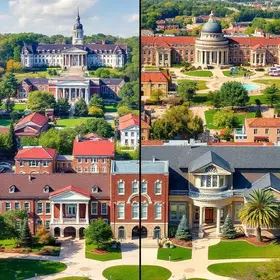
- Florida State College at Jacksonville provides high value, relevant life-long education that enhances the intellectual, social, cultural and economic development of our diverse community.
School Highlights
Quick Facts (26-27)
- Enrollment: 23,556 students
- In-state tuition: $2,830
- Out-state tuition: $9,944
- Student-teacher ratio: 47:1
- Minority enrollment: 57%
- Source: Verified school update
Top Rankings
Florida State College at Jacksonville ranks among the top 20% of public schools in Florida for:
School Overview
Student Body
Showing 2012–2025. View full 19-year historical data
Showing 2008–2025. View full 19-year historical data
Showing 2013–2025. View full 19-year historical data
Showing 2012–2025. View full 19-year historical data
Showing 2013–2025. View full 19-year historical data
Showing 2008–2025. View full 19-year historical data
Showing 2008–2025. View full 19-year historical data
Showing 2008–2025. View full 19-year historical data
Showing 2010–2025. View full 19-year historical data
Showing 2011–2025. View full 19-year historical data
Points are in the dollars of their own College Scorecard release, and the colleges behind the state line differ by period. The lines do not show inflation-adjusted growth.
Tuition & Financial Aid
Showing 2013–2025. View full 19-year historical data
Showing 2010–2020. View full 14-year historical data
Showing 2008–2020. View full 14-year historical data
Sports
School Notes
- The mission of Florida Community College is represented by three waves. One wave represents the Liberal Arts Transfer function students planning to finish a four-year degree after completing freshman and sophomore years at Florida Community College. A second wave stands for Workforce Preparation and Advancement, helping students learn specific skills for specific jobs in our community. The third wave is Community Service, a wide range of classes and services that help our community grow and meet its cultural needs. As these three waves are pulled together by our solid base of dedicated professionals, they form a tetrahedron, one of nature's strongest shapes. The dynamic of the three waves touching each other at the peak of the pyramid allows for easy transfer of energy from one wave to the next, one mission path to the next. Throughout the lifetime of each resident of Northeast Florida, all three waves may come into play, helping to begin a career, advancing a career by teaching new skills or teaching a skill that enhances leisure time or retirement. Florida Community College campuses or centers are located throughout Duval and Nassau counties, offering courses during the day, evening and weekends. Every campus offers adult studies programs (adult high school, GED and adult basic education) as well as the courses required to earn an associate in arts degree for university transfer. But beyond that, each campus has its own specialties, nuances and attributes that make each a little different than the others. Students may choose to attend one or more campuses/centers of their choice, but keep in mind that the core courses for many associate in science and certificate programs are available only at specific locations. Downtown Campus is just a few blocks from The Jacksonville Landing, the heart of urban Jacksonville. The campus, which opened in 1977, is located at 101 W. State St. between Main and Jefferson streets. At Downtown Campus, special emphasis is placed on college credit, continuing education and occupational skills training programs. The campus includes classrooms and laboratories for instruction in such programs as building trades, engineering technology, automotive technology, electrical and metal trades, and English as a second language. Downtown Campus reaches out to many different segments of the community through programs for widowed persons, senior adults, displaced homemakers and visually impaired adults. Major adult basic education, adult high school and GED offerings are available too. The Business and Industry Outreach program offers customized training programs on campus and in-house to local employers.
Frequently Asked Questions
How much does Florida State College at Jacksonville cost?
What is Florida State College at Jacksonville's ranking?
In what neighborhood is Florida State College at Jacksonville located?
Recent Articles