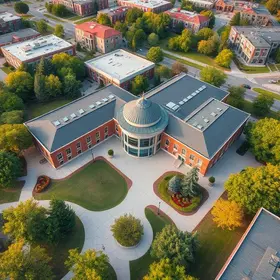
- DBC's Oil City Campus is housed in a classic school building, purchased by DBC and newly remodeled. Classrooms are bright and spacious, equipped with new computers and comfortable ergonomic seating. Most DBC Oil City students are commuters, and the safe suburban location offers convenience and free parking. DBC's Oil City student body includes returning adults as well as new high school grads.
School Highlights
Du Bois Business College-Oil City served 29 students (90% of students were full-time).
The college's student-teacher ratio of 6:1 was lower than the state community college average of 22:1.
School Overview
Du Bois Business College-Oil City
(PA) Community College Avg.
Carnegie Classification
Item not available
Associate's Colleges: High Career & Technical-High Traditional
Institution Level
At least 2 but less than 4 years
At least 2 but less than 4 years
Institution Control
Private, for profit
Private not-for-profit
Total Faculty
5 staff
28 staff
Student Body
Total Enrollment
29 students
350 students
Student-Teacher Ratio
6:1
22:1
# Full-Time Students
26 students
292 students
# Part-Time Students
3 students
88 students
# Enrollment Undergraduate
29 students
366 students
# Full-Time Undergraduate Students
26 students
290 students
# Part-Time Undergraduate Students
3 students
88 students
% White
100%
50%
Diversity Score
0.00
0.00
College Completion Rate (Students who graduate in less than 4 years)
69%
59%
Average Graduate Earnings (10 Years)
$24,900
$34,900
Tuition & Financial Aid
Private State Tuition Fees
$11,505
$17,224
% Students Receiving Some Financial Aid
100%
89%
Median Debt for Graduates
$16,929
$12,696
Median Debt for Dropouts
$6,334
$5,500
Source: 2016 (or latest year available) Integrated Postsecondary Education Data System (IPEDS)
Frequently Asked Questions
How much does Du Bois Business College-Oil City cost?
Du Bois Business College-Oil City's private state tuition is approximately $11,505.
Nearby Schools
The nearest community college to Du Bois Business College-Oil City is University of Pittsburgh-Titusville (12.2 miles away)
School
Location
Miles
Quick Facts

504 East Main Street
Titusville, PA 16354
(888) 878-0462
Titusville, PA 16354
(888) 878-0462
12.2 miles
Enrollment: 40 students Student-teacher ratio: 7:1 Acceptance rate: 47% In-state tuition: $16,992 Out-state tuition: $31,612 Minority enrollment: 6%
300 2nd Avenue, Suite 500
Warren, PA 16365
(814) 230-9010
Warren, PA 16365
(814) 230-9010
36.6 miles
Enrollment: 136 students Student-teacher ratio: 10:1 Minority enrollment: 17%
107 College Drive
Butler, PA 16002
(724) 287-8711
Butler, PA 16002
(724) 287-8711
45.5 miles
Enrollment: 2,317 students Student-teacher ratio: 17:1 In-state tuition: $6,690 Out-state tuition: $9,570 Minority enrollment: 13%
Triangle Tech Inc-Dubois
Private for-profit
225 Tannery Row Road
Falls Creek, PA 15840
(814) 371-2090
Falls Creek, PA 15840
(814) 371-2090
47.9 miles
Enrollment: 20 students Student-teacher ratio: 5:1 Private-state tuition: $16,583 Minority enrollment: 24%
Recent Articles

Online vs. Hybrid vs. HyFlex: Understanding Community College Course Formats
Learn what online, hybrid, HyFlex, synchronous, and asynchronous course labels really mean at community colleges, including attendance, meeting, testing, and participation requirements students should verify before registering today.

Working Student Schedule Test: Night and Online Community College Programs
Learn how working students can test whether a community college program is truly available at night or online, including labs, prerequisites, exams, internships, advising, and course rotations.

Is the Employer Advisory Board Real or Ceremonial?
Learn how to evaluate a community college employer advisory board, verify industry participation, identify meaningful employer influence, and determine whether career connections can benefit students after graduation today.