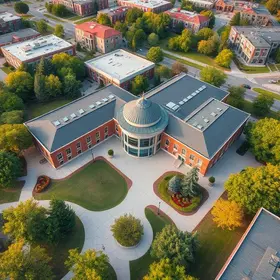
School Highlights
Mason Anthony School of Cosmetology Arts & Sciences served 251 students (38% of students were full-time).
Minority enrollment was 51% of the student body (majority Black and Asian), which was more than the state average of 38%.
School Overview
Mason Anthony School of Cosmetology Arts & Sciences
(OH) Community College Avg.
Carnegie Classification
Not applicable, not in Carnegie universe (not accredited or nondegree-granting)
Baccalaureate/Associate's Colleges
Institution Level
At least 2 but less than 4 years
At least 2 but less than 4 years
Institution Control
Private for-profit
Private not-for-profit
Total Faculty
19 staff
24 staff
Number of Programs Offered
9
7
Student Body
Total Enrollment
251 students
612 students
# Full-Time Students
96 students
342 students
# Part-Time Students
155 students
270 students
# Enrollment Undergraduate
251 students
565 students
# Full-Time Undergraduate Students
96 students
342 students
# Part-Time Undergraduate Students
155 students
402 students
% Asian
13%
3%
% Hispanic
12%
6%
% Black
18%
16%
% White
49%
62%
% Two or more races
6%
4%
Diversity Score
0.69
0.58
College Completion Rate (Students who graduate in less than 4 years)
93%
52%
Tuition & Financial Aid
% Students Receiving Some Financial Aid
100%
91%
Source: 2023 (or latest year available) Integrated Postsecondary Education Data System (IPEDS)
Nearby Schools
The nearest community college to Mason Anthony School of Cosmetology Arts & Sciences is The Spa School (8.3 miles away)
School
Location
Miles
Quick Facts
The Spa School
Private for-profit
5050 N High
Columbus, OH 43214
(614) 252-5252
Columbus, OH 43214
(614) 252-5252
8.3 miles
Enrollment: 111 students Student-teacher ratio: 12:1 Minority enrollment: 46%

550 E Spring St
Columbus, OH 43215
(614) 287-5353
Columbus, OH 43215
(614) 287-5353
9.0 miles
Enrollment: 28,081 students Student-teacher ratio: 41:1 In-state tuition: $4,888 Out-state tuition: $9,998 Minority enrollment: 57%
Felbry College
Private for-profit
6055 Cleveland Avenue
Columbus, OH 43231
(614) 781-1085
Columbus, OH 43231
(614) 781-1085
12.4 miles
Enrollment: 354 students Minority enrollment: 97%
Fortis College-Columbus
Private for-profit
4151 Executive Parkway Ste 120
Westerville, OH 43081
(614) 882-2551
Westerville, OH 43081
(614) 882-2551
14.4 miles
Enrollment: 766 students Student-teacher ratio: 16:1 Acceptance rate: 50% Private-state tuition: $14,641 Minority enrollment: 70%
Hondros College of Nursing
Private for-profit
1105 Schrock Rd, STE 650
Columbus, OH 43229
(855) 906-8773
Columbus, OH 43229
(855) 906-8773
14.4 miles
Enrollment: 3,857 students Student-teacher ratio: 22:1 Acceptance rate: 85% Private-state tuition: $19,220 Minority enrollment: 72%
Recent Articles

Will Your Community College GPA Follow You After Transfer?
Will your community college GPA follow you after transfer? Learn how university grades, transcripts, scholarships, graduate admissions, and academic standing may be affected by your previous college performance.

The Transfer Catalog-Year Trap: What Students Must Check
Could university requirements change before you transfer? Learn how catalog years, continuous enrollment, and degree rules affect your pathway, and what students should verify before choosing university courses.

Transfer Agreements: Admission vs. Your Major
Does your transfer agreement guarantee admission to your major? Discover what happens when universities accept transfer students but restrict entry to specific academic programs and degrees after admission.