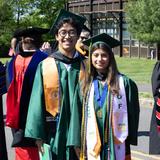

County College of Morris Photo #5

County College of Morris

214 Center Grove Rd
Randolph, NJ 07869
Top-Ranked (2026-27): View Rankings
  • County College of Morris is a public community college in Randolph, New Jersey. CCM offers associate degree and certificate programs as well as transfer opportunities for students looking to pursue a bachelor's degree at another institution, along with workforce development offerings.

School Highlights

County College of Morris serves 6,131 students (44% of students are full-time).
The college's student-teacher ratio of 27:1 is lower than the state community college average of 28:1.
Minority enrollment is 56% of the student body (majority Hispanic), which is less than the state average of 66%.

Quick Facts (26-27)

  • Enrollment: 6,131 students
  • In-state tuition: $7,870
  • Out-state tuition: $10,870
  • Student-teacher ratio: 27:1
  • Minority enrollment: 56%
  • Source: Integrated Postsecondary Education Data System (IPEDS)

Top Rankings

County College of Morris ranks among the top 20% of public schools in New Jersey for:

Category
Attribute

School Overview

The teacher population of 230 teachers has declined by 58% over five years.
County College of Morris
(NJ) Community College Avg.
Carnegie Classification
Associate's Colleges
Baccalaureate Colleges: Arts & Sciences Focus
Institution Level
At least 2 but less than 4 years
Institution Control
Public
Private not-for-profit
Campus Size
222 acres
Total Faculty
230 staff
39 staff
School Calendar

Student Body

The student population of County College of Morris has declined by 8% over five years.
The student-teacher ratio of 27:1 has increased from 14:1 over five years.
The County College of Morris diversity score of 0.71 is less than the state average of 0.76. The school's diversity has grown by 16% over five years.
Total Enrollment
6,131 students
1,147 students

Showing 2012–2025. Full 19-year historical data available below ↓

Student-Teacher Ratio
27:1
28:1
# Full-Time Students
2,711 students
577 students

Showing 2012–2025. Full 19-year historical data available below ↓

# Part-Time Students
3,420 students
570 students

Showing 2012–2025. Full 19-year historical data available below ↓

# Enrollment Undergraduate
6,131 students
1,012 students
# Full-Time Undergraduate Students
2,711 students
503 students

Showing 2012–2025. Full 19-year historical data available below ↓

# Part-Time Undergraduate Students
3,420 students
570 students
% Asian
6%
7%

Showing 2008–2025. Full 19-year historical data available below ↓

% Hispanic
25%
29%

Showing 2008–2025. Full 19-year historical data available below ↓

% Black
5%
17%

Showing 2008–2025. Full 19-year historical data available below ↓

% White
44%
34%

Showing 2010–2025. Full 19-year historical data available below ↓

% Two or more races
3%
3%
% Non Resident races
2%
2%
% Unknown races
15%
8%
Diversity Score
0.71
0.76

Showing 2011–2025. Full 19-year historical data available below ↓

College Completion Rate (Students who graduate in less than 4 years)
33%
40%

Showing 2015–2025. Full 19-year historical data available below ↓

Average Graduate Earnings (10 Years)
$42,100
$37,100

Tuition & Financial Aid

The public in-state tuition of $7,870 is more than the state average of $5,553. The in-state tuition has declined by 20% over four years.
The public out-state tuition of $10,870 is more than the state average of $7,667. The out-state tuition has declined by 20% over four years.
In-State Tuition Fees
$7,870
$5,553

Showing 2008–2025. Full 19-year historical data available below ↓

Out-State Tuition Fees
$10,870
$7,667

Showing 2008–2025. Full 19-year historical data available below ↓

Tuition Notes
$202.00 per credit
% Students Receiving Some Financial Aid
63%
83%

Showing 2013–2025. Full 19-year historical data available below ↓

Median Debt for Graduates
$9,250
$11,000

Showing 2008–2020. Full 14-year historical data available below ↓

Median Debt for Dropouts
$5,500
$5,500

Showing 2008–2020. Full 14-year historical data available below ↓

Source: 2025 (or latest year available) Integrated Postsecondary Education Data System (IPEDS)

School Notes

  • County College of Morris is located on 218 acres of rolling terrain in Randolph. The college first opened its doors to students in 1968 after Henderson Hall, the first building on campus, was completed. The first class consisted of 592 full-time and 703 part-time students. Enrollment grew quickly, and by the fall of 1969, five additional buildings were under way: the library, later named the Sherman H. Masten Learning Resource Center after CCM's first president; Sheffield Hall; the Physical Education Building; the Student Community Center and a service building; all completed by 1970. In the fall of 1973, two additional academic buildings, Cohen and DeMare Halls, were completed. In 1982, the college reached its highest enrollment of 12,012 students. That same year the Dalrymple House was renovated to house administrators. It was renovated again in 1994 to serve as a Child Care Center. Expansion on the main campus continued and in 1994 the college completed the construction of two additions which joined the three academic science buildings. The 20,417 square-foot expansion added classrooms, laboratories, faculty offices, student lounges and an expanded cafeteria. In 1997 the college also opened a six-lane aquatic facility joined to the Health and Physical Education Building. County College of Morris is licensed by the State of New Jersey and accredited by the Commission on Higher Education of the Middle States Association of Colleges and Schools.

Frequently Asked Questions

How much does County College of Morris cost?
County College of Morris's tuition is approximately $7,870 for In-State students and $10,870 for Out-State students.
What is County College of Morris's ranking?
County College of Morris ranks among the top 20% of community college in New Jersey for: Least debt for graduating students.

Recent Articles

Before You Withdraw From a Community College Class
Before withdrawing from a community college class, understand how a W grade affects financial aid, prerequisites, graduation, transfer plans, course attempts, and your future academic options and opportunities for success.
Taking a Semester Off Community College Without Losing Your Place
Can you take a semester off community college without losing your program seat? Learn about leave policies, readmission, financial aid, course sequencing, and steps to protect your enrollment status.
Failing a Course in a Lockstep Career Program
Learn what happens when you fail a course in a lockstep community college career program, including retakes, delayed graduation, readmission requirements, financial aid risks, and practical steps toward recovery.

Quick Facts (26-27)

  • Enrollment: 6,131 students
  • In-state tuition: $7,870
  • Out-state tuition: $10,870
  • Student-teacher ratio: 27:1
  • Minority enrollment: 56%
  • Source: Integrated Postsecondary Education Data System (IPEDS)

Related School Videos

Did You Know?

For New Jersey public community colleges, the average tuition is approximately $5,553 per year for in-state students and $7,667 for out-of-state students. For private community colleges, the average yearly tuition is approximately $16,268 per year. Read more about average community college tuition costs across the country.

The average community college acceptance rate in New Jersey is 72%. Read more about national community college acceptance rates.

New Jersey community colleges have a diversity score of 0.76, which is higher than the national average of 0.74. The most diverse community college in New Jersey is DeVry University-New Jersey. Read more about community college diversity statistics in the USA.

Quick Links