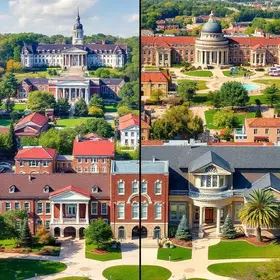
School Highlights
The College of Health Care Professions-Austin serves 974 students (100% of students are full-time).
The college's student-teacher ratio of 26:1 is lower than the state community college average of 34:1.
Minority enrollment is 84% of the student body (majority Hispanic), which is more than the state average of 75%.
Quick Facts (26-27)
- Enrollment: 974 students
- Acceptance Rate: 100%
- Student-teacher ratio: 26:1
- Minority enrollment: 84%
- Source: Integrated Postsecondary Education Data System (IPEDS)
Top Rankings
The College of Health Care Professions-Austin ranks among the top 20% of public schools in Texas for:
Category
Attribute
Programs offered
School Overview
The teacher population of 37 teachers has grown by 164% over five years.
The College of Health Care Professions-Austin
(TX) Community College Avg.
Carnegie Classification
Special Focus Two-Year: Health Professions
Associate's Colleges: Mixed Transfer/Career & Technical-High Traditional
Institution Level
At least 2 but less than 4 years
At least 2 but less than 4 years
Institution Control
Private for-profit
Public
Total Faculty
37 staff
73 staff
Number of Programs Offered
11
9
AccreditationAccred.
Accrediting Bureau of Health Education Schools (ABHES)
Student Body
The student population of The College of Health Care Professions-Austin has grown by 472% over five years.
The student-teacher ratio of 26:1 has increased from 13:1 over five years.
The The College of Health Care Professions-Austin diversity score of 0.66 is less than the state average of 0.69. The school's diversity has grown by 8% over five years.
Total Enrollment
974 students
4,254 students
Student-Teacher Ratio
26:1
34:1
# Full-Time Students
974 students
902 students
# Enrollment Undergraduate
974 students
1,360 students
# Full-Time Undergraduate Students
974 students
869 students
% American Indian/Alaskan
1%
n/a
% Asian
2%
6%
% Hispanic
53%
47%
% Black
18%
13%
% White
16%
25%
% Two or more races
4%
2%
% Unknown races
5%
5%
Diversity Score
0.66
0.69
College Completion Rate (Students who graduate in less than 4 years)
55%
54%
Median Earnings 10 Years After Entry (measured in 2022-2023, in 2024 dollars)
$39,469
$42,382
Showing 2023–2023. Show full history, 2013–2023 (no data for 2014, 2015, 2016, 2017, 2018, 2019, 2020, 2021 and 2022)
Points are in the dollars of their own College Scorecard release, and the colleges behind the state line differ by period. The lines do not show inflation-adjusted growth.
Tuition & Financial Aid
% Students Receiving Some Financial Aid
90%
88%
Median Debt for Graduates
$9,500
$9,500
Showing 2008–2017. Show full history, 2007–2017 (no data for 2009, 2014, 2015 and 2016)
Median Debt for Dropouts
$4,311
$5,250
Showing 2008–2017. Show full history, 2007–2017 (no data for 2009, 2014, 2015 and 2016)
Acceptance Rate
100%
93%
Source: 2025 (or latest year available) Integrated Postsecondary Education Data System (IPEDS)
Frequently Asked Questions
What is the acceptance rate of The College of Health Care Professions-Austin?
The acceptance rate of The College of Health Care Professions-Austin is 100%, which is higher than the state average of 93%.
What is The College of Health Care Professions-Austin's ranking?
The College of Health Care Professions-Austin ranks among the top 20% of community college in Texas for: Most Programs Offered.
Nearby Schools
The nearest community college to The College of Health Care Professions-Austin is Auguste Escoffier School of Culinary Arts-Austin (1.1 miles away)
School
Location
Miles
Quick Facts
Auguste Escoffier School of Culinary Arts-Austin
Private for-profit
6020-B Dillard Circle
Austin, TX 78752
(512) 451-5743
Austin, TX 78752
(512) 451-5743
1.1 miles
Enrollment: 305 students Student-teacher ratio: 23:1 Minority enrollment: 62%
6101 Highland Campus Drive
Austin, TX 78752
(512) 223-7000
Austin, TX 78752
(512) 223-7000
3.4 miles
Enrollment: 39,727 students Student-teacher ratio: 39:1 Acceptance rate: 100% In-state tuition: $3,060 Out-state tuition: $15,624 Minority enrollment: 62%
Universal Technical Institute-West Texas
Private for-profit
301 West Howard Lane
Austin, TX 78753
(737) 284-3100
Austin, TX 78753
(737) 284-3100
6.9 miles
Enrollment: 1,335 students Minority enrollment: 75%
Southern Careers Institute-Austin
Private for-profit
1701 W Ben White Blvd, Ste 100
Austin, TX 78744
(512) 437-7500
Austin, TX 78744
(512) 437-7500
8.2 miles
Enrollment: 746 students Student-teacher ratio: 28:1 Minority enrollment: 71%
The Recording Conservatory of Austin
Private for-profit
4615 City Park Road
Austin, TX 78730
(512) 231-0344
Austin, TX 78730
(512) 231-0344
8.2 miles
Enrollment: 77 students Student-teacher ratio: 26:1 Minority enrollment: 58%
Recent Articles

Fast Credential or Degree Pathway? How to Choose
Short-term training has more funding options, but speed is only one consideration. Compare immediate job preparation with documented degree pathways, remaining coursework, future costs, and realistic plans for returning.

Aerospace & Chip Programs: Should You Follow the Funding?
New investment is expanding technical training, but funding alone should not determine your major. Learn how to evaluate funded programs, student access, career fit, and benefits for your entering class.

Should You Choose a Community College Program Built Around One Major Local Employer?
A community college program tied to one major employer can offer valuable training. Learn how to weigh specialized skills, local job dependence, and your options if that employer changes course.