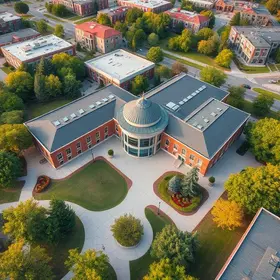
- Since 1902, Indiana Business College, a post-secondary, proprietary educational institution, has been providing men and women with the skills necessary to attain a career in business, industry, and the public sector.
School Highlights
Harrison College-Muncie served 236 students (82% of students were full-time).
The college's student-teacher ratio of 47:1 was higher than the state community college average of 44:1.
Minority enrollment was 100% of the student body (majority Black and Hispanic), which was less than the state average of 55%.
School Overview
Harrison College-Muncie
(IN) Community College Avg.
Carnegie Classification
Associate's--Private For-profit 4-year Primarily Associate's
Associate's--Public Suburban-serving Single Campus
Institution Level
Less than 2 yrs
Four or more years
Institution Control
Public
Public
Total Faculty
5 staff
99 staff
Student Body
Total Enrollment
236 students
3,927 students
Student-Teacher Ratio
47:1
44:1
# Full-Time Students
194 students
1,144 students
# Part-Time Students
42 students
2,783 students
# Enrollment Undergraduate
236 students
1,921 students
# Full-Time Undergraduate Students
236 students
2,566 students
% Unknown races
100%
35%
Diversity Score
0.00
0.66
Average Graduate Earnings (10 Years) (Year 2010)
$26,800
$30,200
Tuition & Financial Aid
In-State Tuition Fees
$12,135
$3,695
Out-State Tuition Fees
$12,135
$7,846
% Students Receiving Some Financial Aid (Year 2010)
76%
56%
Median Debt for Graduates (Year 2010)
$19,319
$12,237
Median Debt for Dropouts (Year 2010)
$7,864
$5,500
Acceptance Rate
78%
75%
Source: 2020 (or latest year available) Integrated Postsecondary Education Data System (IPEDS)
School Notes
- For over 100 years, Indiana Business College's number one goal has been to educate students and have them become productively employed. The college has developed an enviable reputation as a dedicated two-year Associate of Applied Science degree granting institution graduating students from job-oriented programs into successful careers. The IBC Muncie campus is a newly constructed building located on the north side of Muncie, directly across from the Muncie/Delaware county airport. Programs offered at the campus includes Accounting (A.A.S. Degree), Accounting Assistant (Diploma), Administrative Assistant (A.A.S. Degree), Business Administration (A.A.S. Degree), Business Administration/Network Technology (A.A.S. Degree), Business and Information Technology (A.A.S. Degree), Computer Network Technician (Certificate), Criminal Justice (A.A.S. Degree), Medical Assistant (A.A.S. Degree), Medical Coding Technology (A.A.S. Degree), Medical Office Assistant (Diploma), Office Assistant (Diploma) andOrganizational Management (A.A.S. Degree). Indiana Business College is accredited by the Accrediting Council for Independent Colleges and Schools to award Certificates, Diplomas and Associate of Applied Science Degrees. The Accrediting Council for Independent Colleges and Schools is listed as a nationally recognized accrediting agency by the United States Department of Education. Its accreditation of degree-granting institutions also is recognized by the Council for Higher Education Accreditation.
Frequently Asked Questions
How much does Harrison College-Muncie cost?
Harrison College-Muncie's tuition is approximately $12,135 for In-State students and $12,135 for Out-State students.
What is the acceptance rate of Harrison College-Muncie?
The acceptance rate of Harrison College-Muncie is 78%, which is higher than the state average of 75%.
Nearby Schools
The nearest community college to Harrison College-Muncie is Ivy Tech Community College-East Central Region (5.5 miles away)
School
Location
Miles
Quick Facts
4301 S Cowan Rd
Muncie, IN 47302
(765) 289-2291
Muncie, IN 47302
(765) 289-2291
5.5 miles
Enrollment: 12,400 students
2357 Chester Blvd
Richmond, IN 47374
(765) 966-2656
Richmond, IN 47374
(765) 966-2656
36.9 miles
Enrollment: 3,588 students Student-teacher ratio: 37:1 In-state tuition: $3,257 Out-state tuition: $6,761
International Business College-Indianapolis
Private for-profit
7205 Shadeland Station
Indianapolis, IN 46256
(317) 813-2300
Indianapolis, IN 46256
(317) 813-2300
41.9 miles
Enrollment: 123 students Student-teacher ratio: 15:1 Acceptance rate: 75% Private-state tuition: $13,880 Minority enrollment: 28%
1815 E Morgan St
Kokomo, IN 46901
(765) 459-0561
Kokomo, IN 46901
(765) 459-0561
42.3 miles
Enrollment: 5,265 students Student-teacher ratio: 31:1 In-state tuition: $3,257 Out-state tuition: $6,761
Purdue University Global
Public
9000 Keystone Crossing, Suite 800
Indianapolis, IN 46240
(317) 208-5311
Indianapolis, IN 46240
(317) 208-5311
43.8 miles
Enrollment: 38,138 students Student-teacher ratio: 35:1 Acceptance rate: 100% Minority enrollment: 45%
Recent Articles

Can Your Two-Year Degree Really Be Finished in Four Semesters?
Learn how to test whether a two-year community college degree can actually be completed in four semesters by checking prerequisites, course rotations, availability, sequencing, and hidden scheduling barriers.

Program Seat Test: Are You Really Admitted to Your Major?
Learn how to determine whether community college acceptance includes admission to your intended major, and evaluate selective programs, prerequisites, seat limits, deadlines, waitlists, and backup options before enrolling.

Build Your Community College First-Semester Stress Test
Build a realistic first-semester stress test before registration by checking course load, work hours, commuting, finances, family duties, study time, and support systems before your schedule becomes unmanageable later.