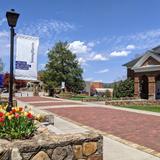
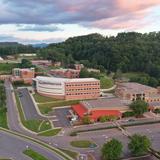
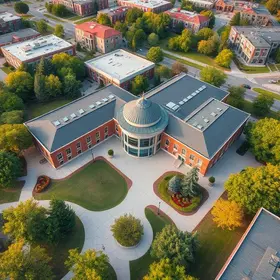
Tri-County Community College is an accredited, comprehensive, publicly-supported, two-year post-secondary institution which operates in accordance with North Carolina Law and the administrative policies of the North Carolina Community College System. Located in the westernmost tip of North Carolina, the College serves commuter students in a remote, rural area consisting of Cherokee, Clay, and Graham Counties by providing college transfer, vocational, technical, and adult education programs.
School Highlights
Tri-County Community College serves 1,265 students (40% of students are full-time).
The college's student-teacher ratio of 7:1 is lower than the state community college average of 13:1.
Minority enrollment is 22% of the student body (majority Hispanic), which is less than the state average of 48%.
Quick Facts (2026)
Enrollment: 1,265 students
In-state tuition: $2,363
Out-state tuition: $8,507
Student-teacher ratio: 7:1
Minority enrollment: 22%
Source: Integrated Postsecondary Education Data System (IPEDS)
Note: Data may not be displayed on any public-facing website or service that replicates or resembles a college search or review portal without prior written permission. See our Terms of Service.
The student population of Tri-County Community College has grown by 27% over five years.
The student-teacher ratio of 7:1 has decreased from 19:1 over five years.
The Tri-County Community College diversity score of 0.38 is less than the state average of 0.66. The school's diversity has grown by 150% over five years.
Note: Data may not be displayed on any public-facing website or service that replicates or resembles a college search or review portal without prior written permission. See our Terms of Service.
Note: Data may not be displayed on any public-facing website or service that replicates or resembles a college search or review portal without prior written permission. See our Terms of Service.
Note: Data may not be displayed on any public-facing website or service that replicates or resembles a college search or review portal without prior written permission. See our Terms of Service.
Note: Data may not be displayed on any public-facing website or service that replicates or resembles a college search or review portal without prior written permission. See our Terms of Service.
Note: Data may not be displayed on any public-facing website or service that replicates or resembles a college search or review portal without prior written permission. See our Terms of Service.
Note: Data may not be displayed on any public-facing website or service that replicates or resembles a college search or review portal without prior written permission. See our Terms of Service.
Note: Data may not be displayed on any public-facing website or service that replicates or resembles a college search or review portal without prior written permission. See our Terms of Service.
Note: Data may not be displayed on any public-facing website or service that replicates or resembles a college search or review portal without prior written permission. See our Terms of Service.
Note: Data may not be displayed on any public-facing website or service that replicates or resembles a college search or review portal without prior written permission. See our Terms of Service.
Note: Data may not be displayed on any public-facing website or service that replicates or resembles a college search or review portal without prior written permission. See our Terms of Service.
Note: Data may not be displayed on any public-facing website or service that replicates or resembles a college search or review portal without prior written permission. See our Terms of Service.
Note: Data may not be displayed on any public-facing website or service that replicates or resembles a college search or review portal without prior written permission. See our Terms of Service.
College Completion Rate (Students who graduate in less than 4 years)
Note: Data may not be displayed on any public-facing website or service that replicates or resembles a college search or review portal without prior written permission. See our Terms of Service.
College Completion Rate (Students who graduate in 4 years or more than 4 years)
Note: Data may not be displayed on any public-facing website or service that replicates or resembles a college search or review portal without prior written permission. See our Terms of Service.
Tuition and Acceptance Rate
The public in-state tuition of $2,363 is less than the state average of $3,915. The in-state tuition has declined by 5% over four years.
The public out-state tuition of $8,507 is less than the state average of $9,508. The out-state tuition has stayed relatively flat over four years.
Note: Data may not be displayed on any public-facing website or service that replicates or resembles a college search or review portal without prior written permission. See our Terms of Service.
Note: Data may not be displayed on any public-facing website or service that replicates or resembles a college search or review portal without prior written permission. See our Terms of Service.
Tuition Notes
in_state:$1,216.00 for 16 or more hours
out_of_state:$4,288.00 for 16 or more hours
Note: Data may not be displayed on any public-facing website or service that replicates or resembles a college search or review portal without prior written permission. See our Terms of Service.
Note: Data may not be displayed on any public-facing website or service that replicates or resembles a college search or review portal without prior written permission. See our Terms of Service.
Note: Data may not be displayed on any public-facing website or service that replicates or resembles a college search or review portal without prior written permission. See our Terms of Service.
Acceptance Rate
n/a
82%
SAT Reading
n/a
488
SAT Math
n/a
498
ACT Composite
n/a
20
ACT English
n/a
13
ACT Math
n/a
16
Source: 2024 (or latest year available) Integrated Postsecondary Education Data System (IPEDS) , School Administrators
School Notes
The roots of Tri-County Community College date back to mid 1964,
when political and educational leaders of Cherokee County met with
representatives of Asheville-Buncombe Technical Institute. That
same year, the North Carolina State Board of Education approved The
Tri-County Industrial Education Center to operate as a part of the
State Department of Community Colleges. Tri-County Community
College have two campuses. Both are located in areas of the Blue
Ridge and Appalachian mountains that are among the most beautiful
and charming places on earth. Quality of life is high. Costs are
low. Outdoor recreation opportunities abound, attracting visitors
from around the world, year-round. We have no residential
facilities on campus, but there are plenty of folks near us who can
accommodate student housing needs. Academic programs currently
being offered are designed within one of the following general
categories: Technical-Programs classified as technical confer an
Associate in Applied Science Degree. These programs are normally
four or five semesters in length; General Education- The general
education program confers an Associate Degree. This program is
normally four semesters in length, and it is designed for those
individuals who normally desire only two years of college; College
Transfer- The program classified as college transfer confers an
Associate in Arts Degree. This program is normally four semesters
in length and is designed for individuals who plan to transfer to a
senior institution for completion of a four year degree. The
college is accredited by the Commission on Colleges of the Southern
Association of Colleges and Schools to award associate degrees.
Frequently Asked Questions
How much does Tri-County Community College cost?
Tri-County Community College's tuition is approximately $2,363 for In-State students and $8,507 for Out-State students.
Explore major 2026 community college trends including enrollment changes, costs, career programs, and affordability for parents planning college decisions.
Explore updated 2026 community college tuition averages, cost trends, planning tips, admissions timing advice, and financial strategies for families and students.
Tri County Community College (2013)
Use one of the services below to sign in to PBS: You've just tried to add this video to your Watchlist so you can watch it ...
Did You Know?
For North Carolina public community colleges, the average tuition is approximately $3,915 per year for in-state students and $9,508 for out-of-state students. For private community colleges, the average yearly tuition is approximately $19,438 per year. Read more about average community college tuition costs across the country.