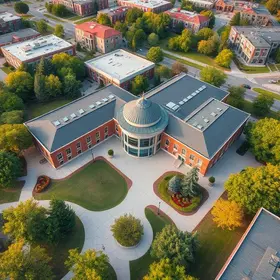
- Glendale Community College is a comprehensive public community college open equally to all adults or high school graduates who can benefit from its programs and services. Its primary mission is to prepare students for successful transfer to four-year colleges and universities or for successful placement or advancement in rewarding careers. Its mission is also to serve its surrounding community through adult non-credit education and community services courses and programs.
School Highlights
Glendale Community College serves 12,075 students (52% of students are full-time).
The college's student-teacher ratio of 32:1 is lower than the state community college average of 44:1.
Minority enrollment is 44% of the student body (majority Hispanic), which is less than the state average of 77%.
Quick Facts (2026)
- Enrollment: 12,075 students
- In-state tuition: $1,175
- Out-state tuition: $5,663
- Student-teacher ratio: 32:1
- Minority enrollment: 44%
- Source: Integrated Postsecondary Education Data System (IPEDS)
Top Rankings
Glendale Community College ranks among the top 20% of public schools in California for:
Category
Attribute
Affordability
Debt For Students
School Overview
The teacher population of 374 teachers has declined by 49% over five years.
Glendale Community College
(CA) Community College Avg.
Carnegie Classification
Associate's Colleges
0
Institution Level
At least 2 but less than 4 years
0
Institution Control
Public
0
Total Faculty
374 staff
72 staff
Number of Programs Offered
-2
8
School Calendar
Student Body
The student population of Glendale Community College has declined by 6% over five years.
The student-teacher ratio of 32:1 has increased from 18:1 over five years.
The Glendale Community College diversity score of 0.60 is more than the state average of 0.00. The school's diversity has declined by 9% over five years.
Total Enrollment
12,075 students
6,838 students
Student-Teacher Ratio
32:1
44:1
# Full-Time Students
6,259 students
1,022 students
# Part-Time Students
5,816 students
5,816 students
# Enrollment Undergraduate
102 students
381 students
# Full-Time Undergraduate Students
6,259 students
967 students
# Full-Time Graduate Students
n/a
96 students
# Part-Time Undergraduate Students
5,816 students
5,798 students
# Part-Time Graduate Students
n/a
21 students
Total Dormitory Capacity
n/a
140 students
% American Indian/Alaskan
n/a
n/a
% Asian
8%
12%
% Hispanic
27%
46%
% Black
3%
7%
% White
56%
23%
% Hawaiian
n/a
n/a
% Two or more races
2%
5%
% Non Resident races
2%
1%
% Unknown races
3%
6%
Diversity Score
0.60
0.00
College Completion Rate (Students who graduate in less than 4 years)
31%
42%
Average Graduate Earnings (10 Years)
$36,000
$34,700
Tuition and Acceptance Rate
The public in-state tuition of $1,175 is less than the state average of $1,236. The in-state tuition has stayed relatively flat over four years.
The public out-state tuition of $5,663 is less than the state average of $6,577. The out-state tuition has declined by 24% over four years.
In-State Tuition Fees
$1,175
$1,236
Out-State Tuition Fees
$5,663
$6,577
Tuition Notes
not free
% Students Receiving Some Financial Aid
85%
85%
Median Debt for Graduates
$7,875
$10,500
Median Debt for Dropouts
$6,500
$6,272
Acceptance Rate
n/a
81%
Source: 2025 (or latest year available) Integrated Postsecondary Education Data System (IPEDS) , School Administrators
School Notes
- Glendale Community College was founded in 1927 to serve the needs of the people in the Glendale Union High School District which included La Crescenta, Glendale, and Tujunga. The school was founded as Glendale Junior College and from 1927 to 1929 conducted classes in the buildings of Glendale Union High School at Broadway and Verdugo in the City of Glendale. In 1929 the junior college moved to the Harvard School plant of the Glendale Union High School District where it remained until 1937. In this year a new plant, part of the present one, was completed and occupied. The year before, in 1936, the Glendale Junior College District was dissolved as such and became a part of the new Glendale Unified School District. The name of the school was changed to Glendale College in 1944. On July 1, 1970 Glendale College became a part of the Glendale Junior College District. On April 20, 1971 the Board of Education adopted a resolution changing the District name to Glendale Community College District. Glendale College is one of 107 community colleges in 72 community college districts throughout the state. Glendale College is known for its academic excellence. We transfer more students to the University of California than any other community college in the vast San Fernando and San Gabriel valleys.Our College Scholars program guarantees acceptance with junior standing at universities nationwide. We also specialize in state-of-the-art career training with high-tech facilities that set the standard for other colleges. There are 22 computer labs on campus. Glendale Community College has a college-credit enrollment of about 15,000 day and evening students, and approximately 10,000 others are reached through the adult education program, specialized job training programs such as JTPA and GAIN, and contract instruction administered by the Professional Development Center. Glendale Community College is fully accredited by the Accrediting Commission for Community and Junior Colleges of the Western Association of Schools and Colleges.
Frequently Asked Questions
How much does Glendale Community College cost?
Glendale Community College's tuition is approximately $1,175 for In-State students and $5,663 for Out-State students.
What is Glendale Community College's ranking?
Glendale Community College ranks among the top 20% of community college in California for: Least expensive tuition and Least debt for graduating students.
In what neighborhood is Glendale Community College located?
Glendale Community College is located in the College Hills neighborhood of Glendale, CA.
Recent Articles

Community Colleges and the Creator Economy
Explore how community colleges prepare students for YouTube, podcasting, content creation, and creator economy careers.

AI-Augmented Careers and Community Colleges
Explore AI-augmented careers and how community colleges prepare students with practical skills, credentials, and employer-aligned training.

Catholic School Marketing Strategies in Competitive Choice Markets
Learn effective Catholic school marketing strategies for standing out in competitive school choice markets in 2026.