
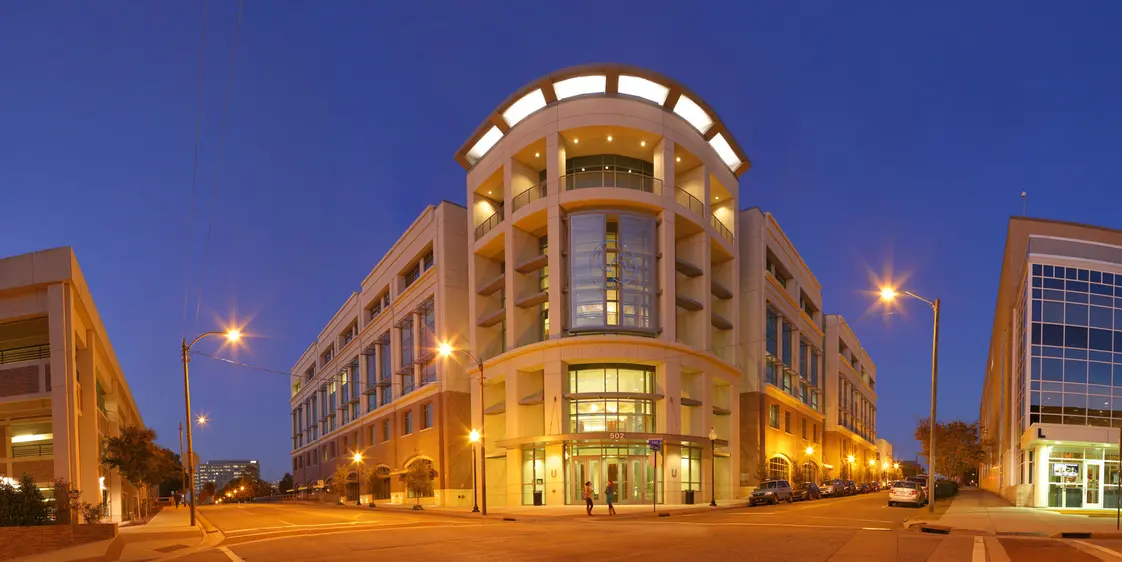



- Cape Fear Community College is a public community college in Wilmington, North Carolina. It enrolls nearly 23,000 students each year.
School Highlights
Cape Fear Community College serves 14,082 students (26% of students are full-time).
The college's student-teacher ratio of 45:1 is higher than the state community college average of 21:1.
Minority enrollment is 33% of the student body (majority Black), which is less than the state average of 50%.
Quick Facts (2026)
- Enrollment: 14,082 students
- In-state tuition: $2,425
- Out-state tuition: $8,569
- Student-teacher ratio: 45:1
- Minority enrollment: 33%
- Source: Integrated Postsecondary Education Data System (IPEDS)
Top Rankings
Cape Fear Community College ranks among the top 20% of public schools in North Carolina for:
Category
Attribute
Community Size
School Overview
The teacher population of 316 teachers has declined by 65% over five years.
Cape Fear Community College
(NC) Community College Avg.
Carnegie Classification
Associate's Colleges
0
Institution Level
At least 2 but less than 4 years
0
Institution Control
Public
0
Total Faculty
316 staff
129 staff
Number of Programs Offered
-2
51
School Calendar
Student Body
The student population of Cape Fear Community College has grown by 62% over five years.
The student-teacher ratio of 45:1 has increased from 9:1 over five years.
The Cape Fear Community College diversity score of 0.52 is more than the state average of 0.00. The school's diversity has grown by 44% over five years.
Total Enrollment
14,082 students
2,143 students
Student-Teacher Ratio
45:1
21:1
# Full-Time Students
3,599 students
650 students
# Part-Time Students
10,483 students
1,493 students
# Enrollment Undergraduate
760 students
300 students
# Full-Time Undergraduate Students
3,599 students
650 students
# Full-Time Graduate Students
n/a
50 students
# Part-Time Undergraduate Students
10,483 students
1,517 students
# Part-Time Graduate Students
n/a
7 students
Total Dormitory Capacity
n/a
719 students
% American Indian/Alaskan
1%
1%
% Asian
1%
3%
% Hispanic
11%
14%
% Black
14%
22%
% White
67%
50%
% Hawaiian
n/a
n/a
% Two or more races
2%
3%
% Non Resident races
n/a
1%
% Unknown races
3%
6%
Diversity Score
0.52
0.00
College Completion Rate (Students who graduate in less than 4 years)
30%
37%
Average Graduate Earnings (10 Years)
$31,600
$27,500
Tuition and Acceptance Rate
The public in-state tuition of $2,425 is less than the state average of $3,915. The in-state tuition has declined by 11% over four years.
The public out-state tuition of $8,569 is less than the state average of $9,508. The out-state tuition has stayed relatively flat over four years.
In-State Tuition Fees
$2,425
$3,915
Out-State Tuition Fees
$8,569
$9,508
Tuition Notes
$76 per credit hour (in-state)
% Students Receiving Some Financial Aid
54%
79%
Median Debt for Graduates
$9,166
$11,865
Median Debt for Dropouts
$5,750
$5,846
Acceptance Rate
n/a
75%
SAT Reading
n/a
488
SAT Math
n/a
498
ACT Composite
n/a
20
ACT English
n/a
16
ACT Math
n/a
18
Source: 2025 (or latest year available) Integrated Postsecondary Education Data System (IPEDS) , School Administrators
School Notes
- Cape Fear Community College has several locations in New Hanover and Pender counties. The largest campus is the Wilmington Campus is located in historic downtown Wilmington n the banks of the Cape Fear River. CFCC's North Campus is located in Castle Hayne, which is home to many of the college's technical and vocational programs. The College also has two Pender County facilities located in Burgaw and Surf City. Day and evening classes are offered at all campuses. Every year, over 27,000 people take classes at Cape Fear Community College. Students can train for a new career in one of CFCC's technical programs or earn a two-year college transfer degree to continue their education at a four-year institution. CFCC also offers a wide variety of adult education and continuing education classes for lifelong learning. CFCC has over 60 technical programs in a wide range of areas to give students hands-on training to get a job right after graduation. In CFCC's very popular college transfer program, students can earn the first two years of a bachelor's degree at a fraction of the cost of attending a four-year college or university. Better yet, when they successfully complete their two-year degree, CFCC graduates can transfer to any four-year college or university in North Carolina. CFCC also offers hundreds of continuing education courses as well. Free programs include basic skills, adult literacy, GED preparation, job skills preparation, adult high school and English as a second language. In the college's Center for Business, Industry and Government, low-cost classes are offered in computer training, construction, foreign languages, leadership and management. The B.I.G. Center even runs customized seminars and specialized for individual businesses. Cape Fear Community College is accredited by the Commission on Colleges of the Southern Association of Colleges and Schools to award associate degrees. CFCC is one of the oldest and largest members of the North Carolina Community College System.
Frequently Asked Questions
How much does Cape Fear Community College cost?
Cape Fear Community College's tuition is approximately $2,425 for In-State students and $8,569 for Out-State students.
What is Cape Fear Community College's ranking?
Cape Fear Community College ranks among the top 20% of community college in North Carolina for: Largest student body.
In what neighborhood is Cape Fear Community College located?
Cape Fear Community College is located in the Historic District neighborhood of Wilmington, NC.
Recent Articles

Community Colleges and the Creator Economy
Explore how community colleges prepare students for YouTube, podcasting, content creation, and creator economy careers.

AI-Augmented Careers and Community Colleges
Explore AI-augmented careers and how community colleges prepare students with practical skills, credentials, and employer-aligned training.

Catholic School Marketing Strategies in Competitive Choice Markets
Learn effective Catholic school marketing strategies for standing out in competitive school choice markets in 2026.