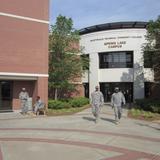
Bladen Community College is dedicated to the educational and cultural enrichment of the people of Bladen and surrounding counties. The College operates as a constituent institution to the North Carolina Community College System and is committed to opening the door to opportunity for citizens seeking to improve their lives and well-being by providing education, training, and retraining for the workplace, including basic skills, literacy, occupational, and college transfer programs; support for economic development through services to business and industry; and services which improve the quality of life for individuals and for our community.
School Highlights
Bladen Community College serves 1,173 students (20% of students are full-time).
The college's student-teacher ratio of 18:1 is lower than the state community college average of 21:1.
Minority enrollment is 59% of the student body (majority Black), which is more than the state average of 50%.
Quick Facts (2026)
Enrollment: 1,173 students
In-state tuition: $2,385
Out-state tuition: $8,529
Student-teacher ratio: 18:1
Minority enrollment: 59%
Source: Integrated Postsecondary Education Data System (IPEDS)
Note: Data may not be displayed on any public-facing website or service that replicates or resembles a college search or review portal without prior written permission. See our Terms of Service.
Note: Data may not be displayed on any public-facing website or service that replicates or resembles a college search or review portal without prior written permission. See our Terms of Service.
Note: Data may not be displayed on any public-facing website or service that replicates or resembles a college search or review portal without prior written permission. See our Terms of Service.
Note: Data may not be displayed on any public-facing website or service that replicates or resembles a college search or review portal without prior written permission. See our Terms of Service.
Note: Data may not be displayed on any public-facing website or service that replicates or resembles a college search or review portal without prior written permission. See our Terms of Service.
Note: Data may not be displayed on any public-facing website or service that replicates or resembles a college search or review portal without prior written permission. See our Terms of Service.
Note: Data may not be displayed on any public-facing website or service that replicates or resembles a college search or review portal without prior written permission. See our Terms of Service.
Note: Data may not be displayed on any public-facing website or service that replicates or resembles a college search or review portal without prior written permission. See our Terms of Service.
Note: Data may not be displayed on any public-facing website or service that replicates or resembles a college search or review portal without prior written permission. See our Terms of Service.
Note: Data may not be displayed on any public-facing website or service that replicates or resembles a college search or review portal without prior written permission. See our Terms of Service.
Note: Data may not be displayed on any public-facing website or service that replicates or resembles a college search or review portal without prior written permission. See our Terms of Service.
Note: Data may not be displayed on any public-facing website or service that replicates or resembles a college search or review portal without prior written permission. See our Terms of Service.
Note: Data may not be displayed on any public-facing website or service that replicates or resembles a college search or review portal without prior written permission. See our Terms of Service.
Note: Data may not be displayed on any public-facing website or service that replicates or resembles a college search or review portal without prior written permission. See our Terms of Service.
College Completion Rate (Students who graduate in less than 4 years)
Note: Data may not be displayed on any public-facing website or service that replicates or resembles a college search or review portal without prior written permission. See our Terms of Service.
Note: Data may not be displayed on any public-facing website or service that replicates or resembles a college search or review portal without prior written permission. See our Terms of Service.
Tuition and Acceptance Rate
The public in-state tuition of $2,385 is less than the state average of $3,915. The in-state tuition has declined by 6% over four years.
The public out-state tuition of $8,529 is less than the state average of $9,508. The out-state tuition has stayed relatively flat over four years.
Note: Data may not be displayed on any public-facing website or service that replicates or resembles a college search or review portal without prior written permission. See our Terms of Service.
Note: Data may not be displayed on any public-facing website or service that replicates or resembles a college search or review portal without prior written permission. See our Terms of Service.
Note: Data may not be displayed on any public-facing website or service that replicates or resembles a college search or review portal without prior written permission. See our Terms of Service.
Note: Data may not be displayed on any public-facing website or service that replicates or resembles a college search or review portal without prior written permission. See our Terms of Service.
Note: Data may not be displayed on any public-facing website or service that replicates or resembles a college search or review portal without prior written permission. See our Terms of Service.
Acceptance Rate
n/a
75%
SAT Reading
n/a
488
SAT Math
n/a
498
ACT Composite
n/a
20
ACT English
n/a
16
ACT Math
n/a
18
Source: 2025 (or latest year available) Integrated Postsecondary Education Data System (IPEDS) , School Administrators
School Notes
Bladen Community College formally opened on December 16, 1967, as
Bladen Technical Institute. Bladen Community College was initially
located in a complex of rented buildings in Elizabeth town. The
College began operation on a full-scale basis in September of 1968.
Initially, curriculum programs were offered in Cosmetology,
Executive Secretarial Science, Business Administration, Industrial
Engineering and Agricultural Engineering Technologies, Industrial
Maintenance, Automotive Mechanics and Nursing Assistant. A complete
battery of extension and other part-time adult programs was started
during the evenings to complement day programs. The name of the
institution was changed to Bladen Technical College in 1979 and to
Bladen Community College in October of 1987. A site for a permanent
campus near Dublin was secured, and phase one of the College
building program began in the spring of 1970. The College moved to
its permanent 25-acre campus in July 1971. Two buildings totaling
27,000 square feet were included in the initial building phase and
housed administrative offices, classrooms, laboratories, shops, a
student lounge, and library. Bladen Community College offers
post-secondary certificate, diploma, and degree programs.
Occupational and vocational courses and programs are also offered
through a variety of Continuing Education offerings. Workforce
development is a priority of the college along with numerous
programs directed at improving basic educational skills, advancing
economic development, and improving the quality of life of Bladen
citizens. The college is accreditated by the Southern Association
of Colleges and Schools.
Frequently Asked Questions
How much does Bladen Community College cost?
Bladen Community College's tuition is approximately $2,385 for In-State students and $8,529 for Out-State students.
For North Carolina public community colleges, the average tuition is approximately $3,915 per year for in-state students and $9,508 for out-of-state students. For private community colleges, the average yearly tuition is approximately $19,438 per year. Read more about average community college tuition costs across the country.