Stafford Loans for Community College Students

Stafford Loans for Community College Students
Published
Written by
Learn more about how Stafford loans help make community college affordable for families.
With costs of tuition, fees, books, and gasoline rising, community college students may need financial assistance today even more than in the past. This article discusses the importance of federal student loans to community college students, the reasons why some students may be unable to obtain loans, and steps that parents and students can take in response to rising costs and dwindling assistance.
 
Federal Family Education Loan Program

Federal student loans, called Stafford loans, are an important resource for all college students. A student can obtain a Stafford loan regardless of the student's income, credit history, or academic performance. Under the Federal Family Education Loan Program, both subsidized and unsubsidized student loans are made by private lenders. Interest on subsidized Stafford loans is paid by the federal government while the borrower is in school and during periods of unemployment or economic hardship. Interest on unsubsidized Stafford loans accrues during such periods. Interest on subsidized federal student loans is capped at six percent, commencing July 1, 2008. A new program for income-based repayment will actually cap the amount of loan payments based on the borrower's income and family size.
 
Note: For more information on loans, see Community College Loans. Other forms of assistance for higher education are Pell grants and private loans. See Community College Grants.
 
Key Role of Stafford Loans in Community Colleges
 
Access to federal loans is important for community college students. Over forty percent of the nation's undergraduates attend community college. Although the costs of attending a community college are typically much less than the cost of attending a four-year institution, many community college students need financial aid. In fact, some of the poorest students in most need of financial aid attend community colleges.
 
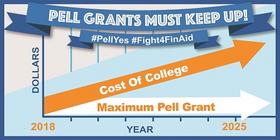
As their first source of financial assistance, many community college students look to Pell grants, which are need-based and do not have to be repaid. Unfortunately, Pell grants have not kept pace with rising college costs. If a student's costs exceed the amount of the Pell grant, the next recourse is a loan. Ideally, the excess costs can be covered by Stafford loans. If there are additional costs, however, a student must resort to a private loan or credit card. Students who need a private loan are at a considerable disadvantage. If they qualify for a private loan, they are facing considerable loan payments upon graduation with none of the protections associated with Stafford loans.
 
Low-income community college students do not have the same access to private loans that more financially secure students have. They may not qualify for a private loan because of their credit history or lack of a co-signer. Lack of assistance may require students to defer beginning college or to cut back on their course load to accommodate a full-time job. Studies have shown that students in such situations are less likely to obtain a degree than other students. Lack of funds may also cause a prospective student to give up on a college education altogether, forgoing completely the brighter future that a college degree would afford. Thus, it is critical that community college students have access to Stafford loans to cover expenses that exceed their Pell grants.
 
Community College Participation in Federal Family Education Loan Program
 
A student is ineligible for a Stafford loan if the school he or she attends does not participate in the federal loan program. About ten percent of community colleges do not participate in federal loan programs, depriving at least one million community college students of access to this important assistance. The primary reason that community colleges decline to participate in the federal loan program is that they fear the college will be disqualified from disbursing Pell grants and other federal aid if there are excessive defaults.
 
According to a recent study conducted by the Project on Student Debt, the risk of a community college being sanctioned for excessive federal student loan defaults is far less than some community colleges believe. If a college has a default rate exceeding 25 percent for three consecutive years, it will lose the ability to distribute Pell grants. According to the study, only one community college in the country had a default rate of over 25 percent in 2005; its rate for 2004 was substantially lower. That community college is not subject to sanctions unless its default rate for 2006 and 2007 also exceeded the 25 percent limit. Moreover, sanctions may be appealed for exceptional mitigating circumstances and other extenuating factors. Debt-counseling assistance has helped some community colleges reduce their default rates significantly. The study recommended that all community colleges participate in the federal loan program in order to give their students access to much-needed loan assistance.
 
Lenders Opting Out of Making Federal Student Loans to Community College Students
 
Yet another fallout from the recent sub-prime lending fiasco is that some major lenders (perhaps as many as 40) are declining to offer federal student loans. Some lenders have withdrawn completely from the student loan arena. Others have dropped community colleges and less-selective four-year institutions while continuing to service loans for students at the more-selective public and private four-year institutions. For example, one lender is believed to have dropped all community colleges in California.
 
One justification for this tactic is that loans to community college students tend to be for smaller amounts and shorter periods. Thus, they are not as profitable as larger, longer-term loans. Also, in 2007, when Congress lowered interest rates on federally subsidized loans, it also lowered the subsidies payable to the lenders. In a period of economic downturn, the lenders are seeking to increase profitability by shedding their less-productive sectors.
 
The result of this tactic is that minorities and other community college students who are in most need of financial assistance have even less chance to obtain it. While big lenders may be within their legal rights to choose their borrowers, many view this blatant form of discrimination in the education arena is unfair and contrary to the long-standing policy of equality in education.
 
Positive Signs for the Future
 
The picture may not be as bleak as previously thought when the lenders first began to withdraw. There are some positive developments that may minimize the impact of their departures.
 
-- Many community college officials do not perceive the departure of some of the big lenders as the crisis it has been portrayed in the press. Financial aid directors report that new lenders are stepping in to furnish federal student. In most cases, schools have been able to find new lenders for students who have been dropped by their current lender. Community college students were able to obtain loans for summer school and, officials say, there will not be a shortage of funds available for the fall.
 
-- Legislation has been introduced in the Senate that would prohibit lenders which participate in the federal loan program from discriminating against particular students or schools. Senator Patty Murray (D. WA), one of the bill's sponsors, stated that "[d]enying loans based on school, program length, or income level locks the door for far too many." The Preventing Student Loan Discrimination Act (S. 3141, 110th Cong., 2nd Sess.) has been referred to the Senate Committee on Health, Education, Labor, and Pensions.
 
-- The U.S. Department of Education has a Direct Loan Program which allows students borrow directly from the Education Department without any involvement of private lenders. Direct Loans are Stafford loans available in the same amounts and subject to the same limitations as Stafford loans under the Federal Family Education Loan Program. The Direct Loan Program's website describes the program as a "simple, inexpensive way to borrow money" to pay higher education expenses.
 
-- Stung by the bad publicity accompanying their withdrawals, a few major lenders which intended to withdraw from making loans to community college students have reversed their positions, announcing recently that they will continue to offer loans to all eligible students.
 
-- Some new websites offer to bypass government involvement by matching up college students with anonymous investors, a process called "peer to peer lending." The new service is not regulated, however, and students should exercise great caution before
participating in peer to peer lending.
 
What Can Parents and Students Do?
 
● Before considering a particular community college, find out whether it participates in the federal loan programs.
● Determine in advance the potential costs for attending the community college of your choice. Consider the expenses of tuition, books, supplies, fees, housing, and commuting. Do not lowball these potential costs. If anything, over-estimate them and assume that they will continue to rise over time. Having a realistic figure for the total costs from the beginning will help in choosing the form of student assistance appropriate for you or your child.
● Consider a compromise. If a student cannot afford to attend community college full-time without borrowing money, consider working part-time while attending school full-time. An alternative is to take a reduced course loan in order to work full-time. While these are not ideal solutions, they are preferable to either borrowing too much or putting off going to college indefinitely.
● Plan ahead. Put money aside for your child's education or participate in state programs such as Coverdell Education Savings Accounts and 529 Qualified Tuition Plans.
● Make every effort to avoid private students loans altogether or to minimize the amount of private loan funds you will require. You do not want to be saddled with burdensome loan repayments after you graduate from college and begin your career.
● If possible, borrow college money from parents and family on favorable terms.
● Some parents are willing to give or loan funds to their children for making a down payment on a home. As a parent, consider investing these funds earlier to help your child get a college education.
 
Conclusion
 
A college degree or training has become increasingly necessary to compete in a global economy. The economic well-being of our country depends in part on providing every citizen the opportunity to pursue a college education. Effective federal funding of education is essential to achieving this goal. At present, while community colleges attract a disproportionate share of low-income students, community college students do not have the same access to federal student loans as students attending four-year institutions. The main reasons for the discrepancy are that some lenders have chosen not to extend federal loans to community college students as part of the recent credit shrinkage and that some community colleges do not participate in the federal loan programs. It is unlikely, however, that community college students will be stuck with this dilemma for long. Legislation has been introduced that would prevent lenders from discriminating against community college students, and the Direct Loan program may fill any gaps left by the departed lenders.

Additional Resources [+]
{"http://www.communitycollegereview.com/articles/33":{"comments":{"data":[]}}}

Federal Work Study Programs: Pros and Cons for Community College Students Federal Work Study Programs: Pros and Cons for Community College Students
Learn about the benefits of a work study program for community college students.

Planning for Student Loans amidst Financial Slow-Downs
Learn how you can find financial aid and support in spite of troubled economic times

comments powered by Disqus

Recent Articles:

What are Community Colleges Doing with Labor Department Grants?
Published May 31, 2013
As the third wave of TAACCCT grants are issued, we take a look at how community colleges are using this federal money to beef up job training programs across the country.

Oldest Community College Graduates of 2013 Oldest Community College Graduates of 2013
We look at some of the less traditional community college graduates gracing stages this graduation season, including some that are well past the average age for community college students.

How Community Colleges Plan to Spend Summer Vacation How Community Colleges Plan to Spend Summer Vacation
We take a look at some of the non-credit classes and special programs on tap and community colleges to bring in members of the community during the summer months.

  • More articles: Choosing a School, Financing, Student Issues / Attending College, Courses in College, Community College News
  • RSS/XML Feed RSS

    Financing:

    Financial Aid

    Make sure you are qualifying for all the financial aid available, as well as maintaining your aid for your entire college career.

    Most Popular Articles: