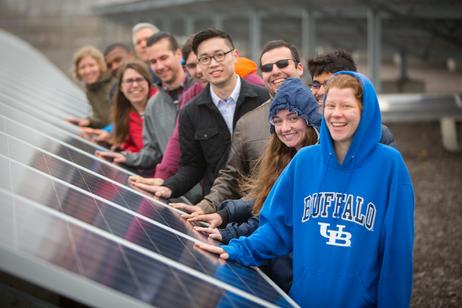
As the demand for environmentally valuable technologies is rising, community colleges across the country are implementing programs to provide students with the skills and knowledge to compete in the future "green collar" job force.
According to The Times Herald-Record, a "green collar" job is a job that "has been upgraded to address the environmental changes of our country." Generated by the need for energy efficiency, careers in fields of energy auditors, weatherization workers, solar electric and water installers, and insulation installers, are all jobs that are projected to be in high demand.
Since the demand is already on the rise, there is already a need for millions of "green collar" workers, and the training demands are immediate. Acknowledging this increasing demand, community colleges are implementing revolutionary programs to prepare students for careers as "green collar" workers in fields of renewable energy. With competitive pay and incredible demand, students are eager to join programs that will lead to sustainable and valuable careers after college.
Community Colleges Gaining Newsworthy Recognition
While community colleges across the country are implementing renewable and green collar programs, Cape Fear Community College, Cape Cod Community College, and Columbia George Community College are just three of the many institutions that have gained media attention for their newsworthy programs and course offerings.
In Wilmington North Carolina, Cape Fear Community College's Engineering Department has developed a renewable energy lab. Focusing on the research and use of hydrogen fuel cells, solar panel innovations, and wind energy, the department is "studying how these resources are used for providing utility grade electricity, and how they can be used for low emission, economically competitive vehicles." In the short term range, the Engineering Department is working to integrate the renewable energy labs into the already existing course offerings at the college. Even more exciting, the department hopes to one day offer a degree program in renewable energy system design and installation.
This video describes the sustainable technologies program at Cape Fear Community College.
Cape Cod Community College
Located in West Barnstable Massachusetts, Cape Cod Community College is now offering a variety of courses in the study of renewable energy. Teaching students about alternative energy sources, financial implications of renewable energy, and transportation innovations, classes include topics such as Renewable Energy Sources, Energy Efficiency and Conservation, and Introduction to Wind Energy.
In the Renewable Energy Sources class, students are provided with a comprehensive overview of renewable energy technologies, such as wind, solar, biomass, and hydropower. Examining the science, the limitations, history, and economics of the technology, the class provides both a social, scientific, and historical approach to this topic. In Energy Efficiency and Conservation, students are able to identify and explain efficiency and conservation methods for the reduction of energy use. While learning to measure and monitor equipment used by energy specialists, students are able to gain real-world insight into renewable energy jobs and careers.
This video outlines the renewable energy program at Cape Code Community College.
Finally, in the Introduction to Wind Energy class, students learn of the power of wind as a sustainable form of energy. Examining the current implications, historical perspectives, and the future potentials of wind power, students are able to learn about the process of "developing, constructing, operating, and maintaining wind energy projects of different scales – from home and small commercial to municipal and utility scale."
Columbia Gorge Community College
With two campus locations in Oregon, Columbia Gorge Community College can impressively boast of their one year certificate or two-year associate degree in the Applied Science Program. With the completion of the course of study, students actually earn their degree in Renewable Energy Technology.
The program aims to prepare students for careers and job opportunities in a wide range of industries. As the college describes, "These include hydro-generation, wind-generation, automated manufacturing, and engineering technicians. In the near future, we are expecting to add solar array (farm) technicians to this list of employers."
This video outlines the renewable energy program at Columbia Gorge Community College.
According to Columbia George, entry-level jobs in renewable energy range from $13 to $15 per hour, and the one year certificate provides students with the necessary skills and information to be well prepared for such employment opportunities. Also, for students with a two-year degree in Renewable Energy Technology, can anticipate wages ranging from $26 to $36 an hour, with the potential to earn even more.
The Potentials of a Green Job
According to The Daily Green, the eco-friendly market, like the solar and wind power companies, have generated over $63 billion dollars in investments in 2006-2007 alone. Since the green field is so vast and diverse, careers are available from "writers and graphics specialists to engineers, ecologists, planners, and financiers."
To prepare for the many career opportunities in the green field, a college course in the field of ecology, biology, geology, oceanography, meteorology, physics, chemistry, and renewable energy courses will help provide students with the necessary background information and knowledge. For more job ideas in the green field, visit green websites, such as www.ecoemploy.com, where you can discover more information about the opportunities in this booming industry – and how community colleges can get you there.
Questions? Contact us on FAcebook. @communitycollegereview