Whether you’re interested in entertaining, sharing insightful commentary, reporting interesting news stories, or working in production, a career in broadcasting and radio may be perfect for you!
According to the Bureau of Labor Statistics, individuals in broadcasting can enjoy a medley of careers, although there is a wide range in income. For example, based on data from 2006, a station operations manager earned an average of $41 per hour, while producers earned approximately $27 per hour. The average income of reporters and announcers range from around $12 to $17 per hour.
If you feel you have the charisma and drive work in this interactive field, then begin your journey with the right training at your local community college.
Careers in Radio Broadcasting
Depending on one’s professional goals and interests, students can pursue a variety of degree pathways to develop the necessary skills for a career in radio.
Commonly, students pursuing a career in professional radio earn their Associates of Applied Science degree. Students can enroll in departments such as broadcasting, telecommunications, or even specialized programs designed for radio technology and production. In examining some of the core classes often required by such programs, students may need to complete mandatory classes such as:
- History of broadcasting radio
- Public speaking
- Radio broadcasting and writing
- Advertising
- Related technology and computer courses
- Related legal courses pertaining to FCC guidelines and broadcasting laws
While each college has its own course requirements, broadcasting programs can often expand to include training for television, as well as radio. For example, students enrolled in Cayuga Community College’s Telecommunications program are exposed to combined instructional models to learn about both radio and television broadcasting. As a result, students in the program enjoy courses such as “Journalism Practicum,” “Interactive Media Production,” “Media Writing,” “Audio for Media,” as well as “Radio Practicum” and “Radio and TV Announcing.” Every community college’s broadcasting program varies, and some may be specialized specifically in radio. Examining the details and curriculum for each broadcasting program can help students choose the best training for their career interests.
By pursuing coursework through Palomar Community College’s radio and television program, students learn about the history, skills, and abilities needed to be a successful radio professional. At this community college located in Oceanside, California, some of the most popular courses include Radio Production or Sports Broadcasting.
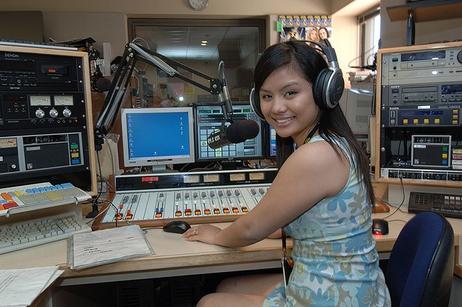
Enhancing the theoretical coursework is PCC’s radio station, where students can enjoy hands-on experience in the industry. Palomar College Radio provides students with the opportunity to work as show hosts, newscasters, reporters, and sportscasters. As their experience grows, students can also work their way up to become the radio station’s Program Director, Music Director, Production Manager, Promotion Director, PSA Director, and News Director.
This video describes the DBA/CINE program at Palomar College.
Students attending Bellevue Community College, located in Washington, can also pursue courses in Audio Production and Broadcast, as well as options in the field of Community Radio Journalism.
For those interested in Audio Production, BCC students can take advantage of an intensive eight-week class that instructs students on the technical elements of radio. Among the core focuses, students learn about digital audio, recording, production, editing, and additional technical elements of sound.
For the Radio Journalism pathway, students can participate in courses that discuss the ethics of journalism and broadcasting, as well as instruction for writing reports and articles for radio broadcast. In addition, participants can also observe and engage in news production opportunities at the college’s news station.
This video describes the steps you should take in college and after graduation to help you succeed in broadcast journalism.
Offering a different approach, schools such as Mercer Community College, located in West Windsor, New Jersey, hone students’ skills in the research and writing behind radio programming. By enrolling in courses such as “Writing for Radio and TV,” students are taught how to write short radio commercials, news copies, interviews, public service announcements, as well as story features. As MCC broadcasting leaders assert, courses in radio writing are designed, “To acquaint students with […] understanding of the terms and techniques of broadcast writing.” Additionally, MCC radio writing students are able to learn the challenges of coping with time restraints that exist in the real-world workforce of broadcasting.
This video explains music technology, the skills needed and acquired in the field and the many job opportunities.
Indeed, there is a wide array of career opportunities that await the budding radio professional. By starting at your local community college, you are quickly on your way to being a part of the FM and AM radio waves.
Questions? Contact us on Facebook. @communitycollegereview