
The advent of the internet has revolutionized society, and education has been dually impacted. With the rise in internet technologies, an increasing number of college courses are moved online – allowing students to learn with sheer convenience. Indeed, the National Center for Education Statistics reported in 2006 that more than 62% of all community college students take courses online.
Community colleges have paved the way for online courses, and students are noticing. In fact, according to research conducted by the Sloan Consortium, two-year community colleges have experienced the highest growth rate in online education, accounting for more than 50% of all online course enrollments in the past five years. The enrollment in online courses at community colleges surpasses the numbers of all other higher education programs combined.
Nationally, according to the Online Learning Consortium, approximately 20% of college students in America took an online course during the fall semester of 2006, which equates to 3.5 million students. In addition, the Sloan Consortium research found that enrollment in online courses is growing at a rate significantly faster than the standard student-growth rates.
Advantages to online curriculum
As more careers and jobs require technical skills in computing and internet research, students who do not develop these skills are quickly left behind in competitiveness. Therefore, online courses offer several benefits, such as convenient learning and an opportunity to hone your technical skills.
- Convenience: Taking an online course allows you to progress through the class at your own pace. If you have a job during the day, you can watch your lectures at night and participate in discussions at your convenience.
- Increased offerings: Online courses can provide students with greater learning offerings. Whereas some classes may not attract a sufficient number of students within a physical campus, an online curriculum can pull together the interest of students from different campuses – which ensures that less common classes are offered.
- Unlimited locations: Regardless of your physical location, you simply need an internet connection to start learning. Therefore, you save the commute time going to and from a physical campus. In addition, if you live in an area that is not close to a community college, you can still benefit from educational opportunities. On the other hand, great professors who may not live near a college campus can nonetheless share their knowledge and teaching expertise.
- Greater interaction: The advancements of internet technology allow for a higher level of interaction and discourse. Students can easily share ideas, comments, and debates via message boards. With multimedia complements, this increases the probability that you will better digest the material.
- Equivalent cost: If you are enrolled as a community college student, taking courses online cost the same as physical classroom courses. Therefore, you benefit from the convenience of distance education – without any additional costs beyond your standard tuition fees.
Choosing between your online course options
Indeed, not all online classes are created equal, and it is important to evaluate the differences to find the best ones for you. There are several ways a course could be offered online:
- Traditional classroom with online components: Many community college courses have a portion of their class taught online, which supplements the in-classroom education. In this scenario, your professor may post assignments, handouts, and literature online. However, the bulk of the course is taught in a traditional classroom, where you listen to lectures and engage in discussions.
- Courses enhanced online: Similar to the class with online components, a course that is “enhanced” typically entails the utilization of Blackboard / WebCT, an online platform that allows professors and students to interact with each other. Sharing documents and engaging in discussions are facilitated through the online boards. However, in this scenario, Blackboard is simply used as a complement to the traditional class.
- Hybrid course: Utilizing the Blackboard / WebCT application, a hybrid course consists of an even mix of online and traditional classes. Therefore, some of the in-class meetings are replaced with online meetings. For example, whereas you may be required to attend lectures in class once a week, you can also attend one lecture and one discussion online.
- Fully online course / web-delivered: In this scenario, there are no in-classroom meetings. Rather, all lectures and discussions are fully conducted online through an application such as Blackboard / WebCT. However, some community colleges will require you to take the midterm or final (if there is one) on campus, while all curriculum is taken online. Therefore, if you are considering taking an online course at a community college that is not within your vicinity, ensure that your midterm and final exam can be taken online.
Within all of these course offerings, there are different methods in which the class is conducted. For example, there is a large difference between a course that is “regular term” and one that is “asynchronous.” Whereas the latter allows you to progress through the course at your own pace, the former requires that all students learn according to the same timing milestones.
When you are making your decisions regarding online courses, keep in mind that some topic matters are more conducive to online learning than others. For example, a class on website programming is much easier to facilitate online than one on art sculpture. Although many community colleges utilize these measures to determine which classes can be offered online, it is important that you conduct your own analysis – choosing classes that will have strength in the online medium.
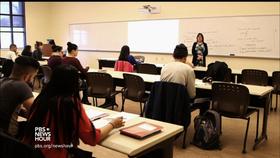
This video explains how to choose your classes.
Obtaining your complete education online
The prevalence of the internet and growth in communication technologies have allowed community college students to obtain their entire Associate degree completely online through distance learning. The Sloan Consortium found that approximately 42% of community colleges offer complete online learning classes, meaning that the entire education is conducted through distance learning. Without ever having to step foot into a physical classroom, students can obtain a quality education from the comfort of their own home and schedule.
According to the Sloan Consortium’s Journal of Asynchronous Learning Networks, one of the national models for distance learning is Rio Salado, a Maricopa Community College located in Phoenix. With more than 21,000 students strictly enrolled in distance education, these individuals have obtained their AA, AS, AAEE, ABus GR, and other Associate degrees strictly through learning from online courses. From online courses, students have obtained a large array of degrees, which are representative of other community college distance learning programs as well:
- Behavioral Health / Chemical Dependency
- Computer Technology
- Early Childhood Education
- Law Enforcement Technology
- Nursing
- Organizational Management
- Public Administration
- Retail Management
- Teacher Education
- General Education degrees: Art, Biology, Chemistry, Computers, Communications, English, Foreign Languages, Geology, History, Humanities, Math, and Social Sciences Of course, not all community colleges offer a complete distance education program that will allow you to earn your degree strictly online. However, there are many community colleges that do, and this is a great option for students who may not live in the vicinity, or who may have work or personal constraints that make a physical campus inconvenient.
The flexibility of online courses allows you to essentially design your own education, especially in terms of scheduling and delivery. You can certainly choose to enroll in a 100% distance education community college, or you can find a middle ground between a combination of online courses and traditional classrooms. The majority of community colleges offer online classes, and with nearly two million community college students taking at least one online course, the convenience of distance learning is clear.
To ensure that you can obtain the best education from an online community college course, be certain that your computer has the appropriate system and that you have internet access. Many of the online classroom platforms, such as Blackboard, have minimum system requirements.
However, once you have your tech equipment in place, online learning is convenient, easy, and powerful – allowing you to enhance your academic edge based upon your own schedule. With millions of students experiencing the convenience of online courses, you can obtain the education that you deserve at a time and pace that is best for you.
Questions? Contact us on Facebook @communitycollegereview